Showing posts with label 1948. Show all posts

Friday, October 10, 2014

2014 Midterm Election's Billion Dollar Budget vs Harry Truman's 1948 Whistle Stop Shoestring

One billion dollars. That's how much candidates for the upcoming US midterm elections have raised for their House and Senate campaigns. A billion freaking dollars! And actually, according to figures released by the FEC and shared by Opensecrets.org, that's rounding down. With more than six weeks to go until election night, the total might jump up to $1.5 billion. That's what it takes to take candidates around their states in nice air conditioned RVs and private planes, and, of course, to film horrendous TV promos (though they'll be hard pressed to beat Jeff Wagner's ad from the 2013 Minneapolis mayoral race). In the 2012 Presidential election, Barack Obama and Mitt Romney spent almost $2 billion.
Rewind to 1948, before the days of super PACs, TV debates and, well, shirtless guys climbing out of lakes to drink coffee, and you'd find a completely different campaign cycle. Nobody likes to back a loser, and that's just what most journalists, politicos and pollsters thought President Harry Truman would be come election night.
2014-09-25-WildaboutHarry.jpg
Thrust into the White House by the untimely demise of Franklin Roosevelt two years before, Truman had helped the Allies win the war in the Pacific with a decision no leader should have to make. Then he squared his shoulders as peacetime problems marched toward him, overcoming millions of workdays lost to strikes and taking two giant steps forward in civil rights by ending pay discrimination for federal employees and desegregating the US Armed Forces.
And yet the Southern Democrats (aka Dixiecrats) had broken away in protest of this civil rights program, rallying around J. Strom Thurmond, the fiery former Governor of South Carolina who declared that "there's not enough troops in the Army to break down segregation." The Democratic Party also split to the left, with former Vice President Henry Wallace calling for a conciliatory stance toward Soviet Russia and nationalized industries as leader of the Progressive Party.
2014-09-25-DeweyWhiteHouseAssoffGrass.jpg
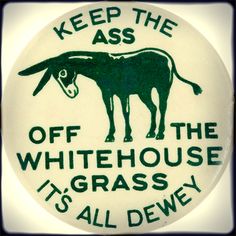
Meanwhile, the Republicans, out of power since FDR won the 1932 election, believed they would recapture the White House by putting debonair former New York Governor Thomas E. Dewey - who'd come closest of all GOP candidates to defeating FDR - and likable California Governor Earl Warren on a "dream ticket" that had the media fawning. In fact, more than two thirds of editors surveyed midway through the campaign believed Truman was done, a verdict backed up by Dewey's double digit polling leads.
So how bad did things get for Truman's finance team? Well, the President clambered on top of a chair at a White House fundraiser, and pleaded for contributions from a room of wealthy backers: "I am appealing for your help. Help to carry my message to the American people. We just haven't got the money to buy radio time. In Detroit on Labor Day we had to cut out one of the most important sections of my speech because we didn't have the money to stay on the air." The Chief Executive was certainly being truthful: despite Oklahoma Governor Roy Turner cutting a last minute check to radio networks so they'd broadcast Truman's Cadillac Square address, Truman had to edit his concluding remarks. But climbing on a chair to beg wasn't Presidential, his detractors scoffed, with Drew Pearson lamenting in his daily 'Washington Merry Go-Round' column that Truman looked "pathetic and alone."
The chair-top appeal did convince some donors to cough up, including two who gave $10,000 a piece on the spot. But the money didn't get the President very far, literally or figuratively. As his train car, the armor-plated Ferdinand Magellan, chugged into Oklahoma in the final days of September, Truman had reached the end of the line. Hearing that the Democratic National Committee was hard up, the railroads took a page from the radio network's playbook, demanding up front payment for fuel and other fees. The trouble was, the coffers were empty. For Truman to continue on his 31,000 mile Whistle Stop Tour that he had started in June and complete the rest of the planned 352 speeches (he gave up to 16 a day), it looked like he'd need an act of God.

Click here to read the rest of the post at The Huffington Post.

And don't forget to click here to pre-order your copy of Whistle Stop: How 31,000 Miles of Train Travel, 352 Speeches, and a Little Midwest Gumption Saved the Presidency of Harry Truman.

Want to buy a signed copy? Then e-mail me today and we'll figure it out.

Monday, November 5, 2012

An Election Apart: Harry Truman and the Last Time an Incumbent President Was Strapped for Cash

In our hyperbole-infected 24/7, anywhere, anytime news cycle, many reporters have become too quick to judge elections in exaggeration. If you believed stories from the Obama-Romney coverage chapter and verse, you’d think this was “the most negative campaign ever.” Never mind that contest between two chaps by the names of Adams and Jefferson, in which Jefferson’s election managers slammed Adams as a "hideous hermaphroditical character, which has neither the force and firmness of a man, nor the gentleness and sensibility of a woman." Sniping back, Adams’s team dismissed Jeffersonas "a mean-spirited, low-lived fellow, the son of a half-breed Indian squaw, sired by a Virginia mulatto father.”

Depending on where your political sympathies lay, you’d also be resolved that Mitt Romney orpresident Barack Obama were the two most mendacious candidates of any that have vied for the White House. Hmmm. Because political candidates never stretch or bend the truth to further their arguments, of course. Like the time that Al Smith’s detractors took their anti-Catholicism line intocomical territory by circulating a photo of Smith dedicating a new tunnel and claiming he was planning to extend the passageway under the Atlantic to Rome, so he could take direct orders from the Pope if he became president.

But one claim about this year’s Obama-Romney face off that is accurate is that it is the most highly funded election in US history, with more than $6 billion dollars flowing into Democratic and Republican coffers, and then out again to pay for TV ads, logistics, calling campaigns and the rest.

This cash-rich election is the opposite of another that I’ve been spending an inordinate amount of time studying lately: The Harry Truman vs. Tom Dewey presidential election of 1948.

Clifford K. Berryman, October 19, 1948
Before we look at the money side, let’s first look at the context of this election. Franklin Delano Roosevelt, who had been president for 12 years, authored the New Deal, forged the historic wartime alliance with Winston Churchill and become an indelible imprint on the nation’s consciousness, died on April 12, 1945. In his place was a man who had been vice president for just 82 days, and was as unlike Roosevelt as was possible. FDR was born into privilege, had been to the best schools, and mixed in the elite East Coast liberal circles, making his ascension to the presidency seem natural and, in some ways, almost pre-destined. In contrast, Harry Truman had been a soldier, a farmer and a failed haberdasher, had never been to college, and preferred to mix with his old friends from Missouri. Yet, with FDR gone, he was now at the helm of the US, which had become an industrial powerhouse during World War II.

Just three months into his presidency, Truman was charged with brokering a lasting peace with Churchill and Joseph Stalin at Potsdam – though Soviet hegemony in Eastern Europe was a fait accompli and Stalin wasn’t well known for bending for anyone, let alone a rookie president, albeit it a fiery one.

Then, in August 1945, Truman was faced with the monumental decision of whether to use the fruits of the Manhattan Project to force Japanese surrender. Believing his generals’ assertions that bombing Hiroshima and Nagasaki would save up to 500,000 American troops, he authorized this decisive, and most deadly, action.

When the war ended, organized labor wanted pay rises to compensate for stagnant levels during the war, while industrial leaders desired increased prices and keeping wages steady. Massive strikes ensued, with 116 million of work days lost in 1946. Truman recognized the need to keep the Democrats’ traditional labor voting happy, but couldn’t tolerate it when the UAW, AFL, CIO, coalminers, John Lewis’s steelworkers and others brought the country’s economy to a standstill. So he seized the mines, the steelworks and the railroads, telling train worker leaders A.F Whitney and Alvanley Johnson in the Oval Office, “I’m going to give you the gun.” Truman was pulled back by special counsel Clark Clifford when he wanted to tell Congress he should hang a few strikers to send a message to Big Labor, though in his revised speech to a joint session on May 26, he did ask for the right to draft strikers into the Army – a proposal that didn’t become law.

To add to Truman’s woes, the GOP seized control of the House and Senate in the 1946 midterms. And as Truman’s lame duck Presidency continued to struggle, his pursuit of a bold civil rights plank, passage of Executive Orders to desegregate the US armed forces and ensure equality for civil servants of all ethnicity and speech to the NAACP caused Southern Democrats to break away and form the States Rights Democratic Platform. One split in the party would’ve been bad enough, but former vice president Henry Wallace captured the imagination of the far left when he formed the Progressive Party. To make matters worse, the New Deal old guard, including Eleanor and James Roosevelt, had little to no confidence in Truman, considering him to be a poor substitute for the giant of the age, FDR.

The hapless Truman had no reprieve in foreign affairs. Not only was Stalin securing his grip on Eastern Europe, he was also demanding bases in Turkey, providing support to Greek Communists and threatening the vital British trade route through the Suez Canal. In Asia, Moscow was backing Mao’s takeover in China and, foreshadowing the coming conflict, periodically cutting off power to South Korea. And then, Truman controversially recognized the nascent Israeli state on May 14, 1948, the first world leader to do so. A month later, the Soviets started the Berlin Blockade, refusing to allow food, medical supplies or other aid to flow from the Allied-controlled zones.

With such calamities at home and abroad, Truman would have struggled against any Republican opponents in the 1948 election. But when the GOP nominated the ‘dream ticket’ of New York Governor Thomas Dewey and popular California Governor Earl Warren, a whole forest was thrown onto the fire. Clare Booth Luce, wife of Time publisher Henry, spoke the opinions of many when she said that the Man from Missouri was a “gone goose.”

Click here to read the rest of this post at the blog of Boston University's The Historical Society