Showing posts with label Harry Truman. Show all posts

Wednesday, December 10, 2014

A Political Apprenticeship: What Winston Churchill Taught Harry Truman

The two men couldn't have been more different. One was born in a magnificent palace, the other in a humble farmhouse. One had been in politics for 40 years, the other was a relative newcomer. One was lauded as his country's greatest Prime Minister. The other was derided as an accidental President.
And yet, as the Allies won World War Two and tried to make the peace, Winston Spencer Churchill and Harry [invented middle initial] S. Truman came together to check the advance of expansionist communism.
When the two first met in the grounds of the Cecilienhof Palace in Germany in July 1945, the overtones of the Potsdam Conference could not be more clear, or more menacing. A giant red star was daubed on the main lawn, and having sacrificed up to 20 million Soviet lives to repel the Wermacht on the Eastern Front, the ruthless Joseph Stalin was expecting a large slice of European pie as a reward.
2014-12-08-PotsdamStar.jpg
Since well before he ran one of the most dogged and, ultimately, successful PR campaigns of his career to court Franklin Roosevelt's support in 1940 and 1941, Churchill had realized that for democracy to survive the Nazi assault America would have to be the senior partner, and his beloved Britain the junior. With FDR now gone, it would be up to Truman to prevent Stalin from consuming all of Eastern and Central Europe, and perhaps more.
The two men liked each other from the get go, though their initial impressions are amusingly different. Truman thought that they'd get on fine as long as Churchill didn't give him too much "soft soap" - i.e the lofty words and flattery that had wooed FDR. The British bulldog, who had taken the measure of every world leader since the early 1900s, believed Truman to be a man of immense determination. "He takes no notice of solid ground whatsoever," Churchill told his physician. "He just plants his foot down on it." The Prime Minister lifted his bulk a couple of inches into the air and crashed down on his private bathroom floor to illustrate his point.
If Churchill recognized before flying to Potsdam that he would need every ounce of Truman's influence as the head of the West's new superpower, it soon became clear just how much would depend on the Man from Missouri. Halfway through the conference, Churchill flew home to receive news of what he hoped would be victory in the General Election. Instead, his Conservative Party suffered the second worst defeat in its history, meaning Churchill would play no further part in the deliberations. In his stead went the new PM Clement Attlee, a man Churchill had once allegedly referred to as "a sheep in sheep's clothing." What good would a meek lamb be against the Soviet bear?
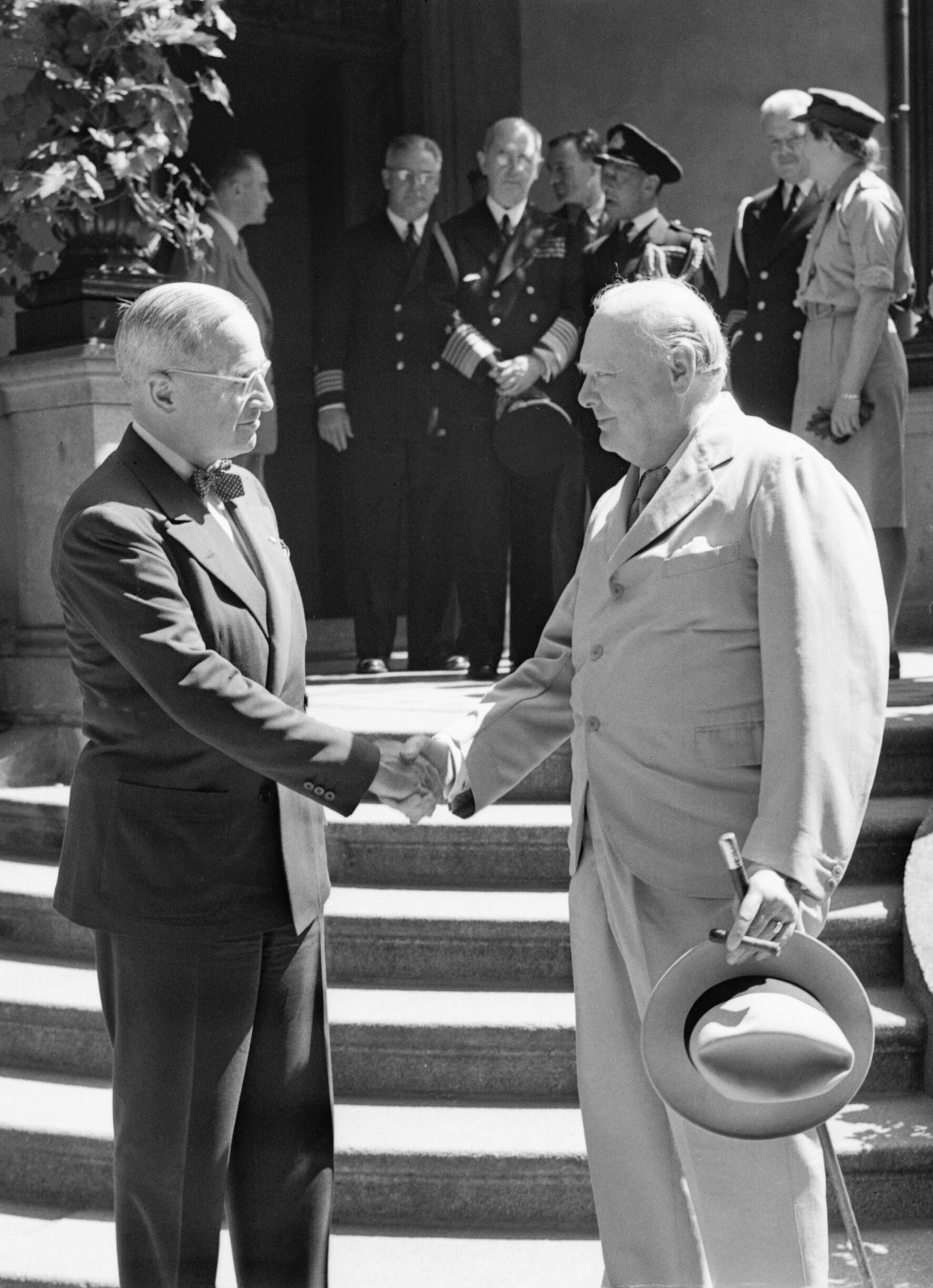
2014-12-08-ChurchillTrumanPotsdam.jpg
The answer was simple: not much. And neither did Truman win many concessions that favored the Western democracies around the Potsdam negotiating table. Stalin and his cronies got what they came for, except for Greece, which Churchill said he had "pulled from the fire on Christmas Day" during the war, but which would still be menaced by Communist revolutionaries for several years.
The Truman-Churchill story resumed in March 1946 in an unlikely venue: Truman's Presidential train car, the Ferdinand Magellan. As the locomotive sped from Washington to St. Louis, Truman's aides schooled Churchill at the poker table. But card games aside, it was Churchill who was the real teacher. The record of Churchill and Truman's conversation is unavailable, but as the American President is noted for his endless quest for knowledge (he supposedly read every book in his hometown library as a boy) and his British guest for his verbosity, it's likely that the political veteran gave more than a few pointers to his less experienced host.
Churchill was on his way to Truman's home state because the President had added a persuasive postscript to a speaking invitation from Franc Bullet McCluer, who presided over Westminster College in Fulton. Truman offered to introduce Churchill if he accepted, and the Leader of the Opposition recognized that he now had the perfect venue to air his grave concerns over the next great threat to world peace: Communism.
Contrary to his later denials issued when Churchill's "Sinews of Peace" speech whipped up a storm of criticism on both sides of the Atlantic, Truman certainly read and was influenced by what is now better known as "The Iron Curtain Speech." In it, Churchill spoke grimly of the iron curtain that had hewn Europe in two. On one side, Britain, France and a handful of countries were struggling to recover from the war, but their citizens enjoyed the freedoms of liberal democracy in their "cottage homes." Not so on the other side of the Iron Curtain, where the peoples of Central and Eastern Europe were subjected to Soviet tyranny. "This is certainly not the Liberated Europe we fought to build up. Nor is it one which contains the essentials of permanent peace," Churchill asserted in the Westminster College gym, as Truman looked on.

Click here to finish reading this story via The Huffington Post.

And don't forget to order my new book, Whistle Stop: How 31,000 Miles of Train Travel, 352 Speeches, and a Little Midwest Gumption Saved the Presidency of Harry Truman

Thursday, October 30, 2014

The Secret Weapon That Helped Win the White House in 1948 & Establish The Political 'War Room'

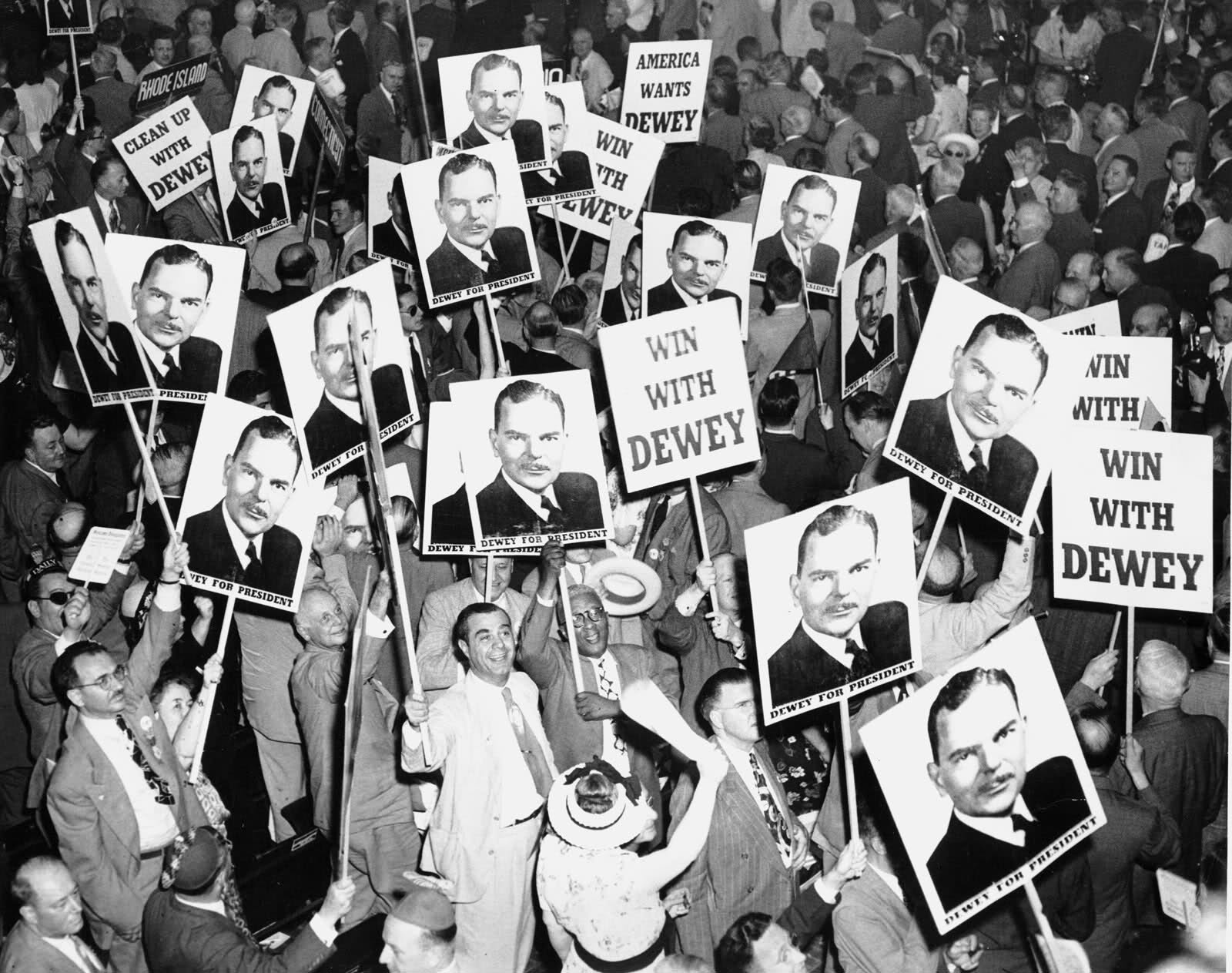
On paper, it looked like Thomas E. Dewey was a shoo-in to win the 1948 election and return the Presidency to his Republican Party after 16 years of Democratic Party rule. He had come within two million votes of beating Franklin Roosevelt in 1944. Four years later it was not the iconic FDR he'd be facing or the wartime unity that he commanded, but Harry Truman, who was mired in misery at home and abroad. The Dixiecrats had splintered off in protest of Truman's bold civil rights program, while former VP Henry Wallace led the Progressives leftward with conciliatory foreign policy and plans to nationalize American industry.
Then there was the aftermath of postwar strikes that claimed millions of work days in 1946 and 1947 and isolated Truman from the unions after he took a hard line stance. The President almost didn't make it onto the ticket at all - the increasingly influential Americans for Democratic Action (ADA) and several big name Democrats wanted Dwight Eisenhower instead, a push only halted by Ike's refusal to run. And abroad Communism was on the march in China, and pushed Truman to the brink when the Soviets cut off West Berlin from food, medical supplies and coal with the Berlin Blockade. No wonder polls put Dewey up to 20 points ahead of the incumbent and almost three quarters of newspaper editors in a September 1948 survey backed the former New York Governor to take down Truman come election night.
2014-10-26-WereWithDewey.jpg
And yet, somehow, Dewey lost the 1948 election and Truman claimed one the most unlikely victories in US history. So just how did the Man from Missouri pull it off? Well, there are a variety of factors, not least carefully targeted campaigning to black voters, farmers and blue collar workers, not to mention Truman's Herculean Whistle Stop Tour, which saw him give up to 16 speeches a day as he traveled 31,000 miles across the nation.
But a less obvious factor in Truman's win and Dewey's demise was the DNC Research Division. Holed up in small, airless offices above a building site in Washington's Dupont Circle, seven men beavered away day and night creating "Files of the Facts" - extensive dossiers on housing, civil rights, education and the other main planks of the Democratic platform. They then sent these to Truman's campaign team, who distilled them into bullet points for the President to review.
The real advantage that the seven journalists, city planners and policy experts provided wasn't macro level overviews, however, but localized details that any modern political "War Room" team would be proud of digging up. Using Works Progress Administration guides and local newspapers from across the country, the Research Division compiled talking points for each of the 352 places Truman spoke in on his June 'inspection tour' out West and the main Whistle Stop Tour in the autumn. As they were such a small group, the staffers were only ever working 48 hours ahead of Truman's train, which received new information when a runner went to the closet municipal airport to get new packets.
The specifics covered all the main election topics. Those who gathered in LA's Gilmore Stadium on September 23 found out that in 1940 only 5 percent of LA homes sold for more than $10,000, while eight years later, that figure had increased to 50 percent - evidence Truman used to call for inflation controls. A Winona, Minnesota audience that listened to the President on October 14 learned that, "Back in the Republican depression year of 1932, Minnesota farmers made less than quarter of a billion dollars. Last year, the income of Minnesota's farmers was a billion and a half dollars."
As well as feeding the President nitty gritty details, DNC Research Division head Bill Batt and his staff critiqued Truman's talks and provided suggestions for improvement. And it was Batt who pushed Truman's aide Clark Clifford to bend the President's ear on calling the "do-nothing" Congress back for a special summertime "Turnip Day" session in his Democratic Convention speech. And that's just what Truman did. The Congressman, spurred by Republican Robert Taft's assertion that "We're not going to give that fellow anything" passed no meaningful laws during this time, giving Truman even more ammunition for his accusation that the Republican-controlled legislative body was failing the country.
2014-10-26-out_of_my_way.jpg
Click here to finish reading this article via Huffington Post UK. 
Learn more about the role of the Research Division in my new book, Whistle Stop: How 31,000 Miles of Train Travel, 352 Speeches, and a Little Midwest Gumption Saved the Presidency of Harry Truman. 
If you'd like to purchase a signed copy of Whistle Stop and/or my previous book, Our Supreme Task: How Winston Churchill's Iron Curtain Speech Defined the Cold War Alliance, please leave a comment below. 

Wednesday, October 22, 2014

The Workaholic as President: How Harry Truman's Whistle Stop Work Ethic Won the 1948 Election

It has become fashionable of late to decry long working hours and claim that anyone who beavers away day and night must have some kind of problem or 'personality disorder.' For years, the European Union Working Time Directive has limited weekly work hours to 48, and in most EU member nations, people are well below that limit: France has a 35-hour work week and Sweden has experimented with a six-hour work day.
In the US, where a blue-collar work ethic has long been a part of the national consciousness, recent Presidents have come under fire for taking too much time off. A New York Times blog post claims that George W. Bush had 879 vacation days, including 77 trips to his Texas ranch. And Barack Obama's love of golf has become so controversial - heaven forbid that Presidents take holidays or exercise! - that there's even a dedicated website keeping track of how many rounds the President plays.
There are no such leisure luxuries when it comes to Presidential campaigns, however, at least with regard to Harry Truman's 1948 Whistle Stop Tour. Coming into the campaign, Truman was no stranger to logging mega miles as a politician. When he was an administrator in Missouri's Jackson County, he drove than 20,000 miles at his own expense looking at designs that would inspire a facelift for his county's courthouse in Independence, Missouri. Truman traveled "as far west as Denver, as far east as Brooklyn, and as far south as Baton Rouge, Louisiana," as one account puts it.
2014-10-18-TrumansplitDemocraticparty.jpg
Then in fall 1944, as the unlikely running mate chosen by Franklin D. Roosevelt as he sought to extend his 12-year stay in the White House, Truman, who had by then served nine years in the US Senate, again became a road warrior. He made more than 200 speeches for the President and his efforts paid off, as FDR defeated Republican candidate Thomas E. Dewey (for more on the 1944 election, see Michael A. Davis's insightful Politics as Usual).
Less than a year later, Roosevelt was dead. And in the election year of 1948 it was Truman's turn to head the Democratic Presidential ticket, with Dewey again his main opponent. But the former New York Governor wasn't his only rival: J. Strom Thurmond threatened to steal Southern votes as head of the 'Dixiecrats' who opposed Truman's civil rights agenda. And the man who Truman had replaced as Vice President, Henry Wallace (who Truman had fired from his post of Secretary of Commerce for criticizing his unflinching policy toward Stalin's Soviet Union) was sure to win some liberal support as he ran for the Progressive Party.
Truman had alienated the powerful labor unions by smashing their post-World War II strikes, which cost the US economy billions of dollars and threatened to shut down the entire economy in 1945 to 1947, with 4.6 million workers walking out in 1946 alone. In the previous election, FDR had also lost ground in America's heartland, where many farmers turned their support to the Republican Party and helped shrink Roosevelt's victory margin to just over two million votes, by far his narrowest election win. Wall Street donors closed their check books for the man most writers, pundits and pollsters predicted would fall to Dewey come November, leading to Truman pleading for funds.
With so many challenges at home and the distraction of the Berlin Blockade abroad, what was Harry Truman to do? Concede the Democratic Party nomination and let someone else run? Not likely. Sit on his hands and let Dewey and his "Victory Special" train waltz to the White House? Not a chance. "I'm going to take Dewey like that!" Truman told Clark Clifford and the rest of his campaign team in a summertime strategy meeting, snapping his fingers for emphasis.
Truman had already traveled more than 9,000 miles on a June 1948 tour out west, giving over 100 speeches to voters he implored to vote for him instead of for what he called "the party of privilege." Now his advisors had planned 250 more talks, which would take Truman more than 22,000 additional miles as he went back and forth across America. His team worried about the physical toll of such an ambitious schedule on the President, who had suffered migraines and stomach issues from work-related stress in the past and whose age (64) put him at another disadvantage to the 46-year-old Dewey. "I'll be alright," Truman assured them with a trademark grin. "It's YOU I'm worried about."

Click here to finish reading this story via The Huffington Post.

Want to learn more? Then click here to order my new book, Whistle Stop: How 31,000 Miles of Train Travel, 352 Speeches, and a Little Midwest Gumption Saved the Presidency of Harry Truman.

If you'd like to purchase a signed copy of Whistle Stop and/or my previous book, Our Supreme Task, please leave a comment or e-mail me.

Wednesday, October 15, 2014

I Like Ike - Military Presidential Candidates From Eisenhower to Tom Cotton

In the election year of 1948, Republican Party bigwigs were feeling pretty pleased with themselves. President Harry Truman's Democratic Party was splintering, with Southern 'Dixiecrats' bolting in protest of Truman's civil rights agenda and Henry Wallace leading the Progressive Party leftward. The GOP was far ahead in fundraising, and Truman trailed Republican candidate Thomas E. Dewey by double digits in the polls, while the American press lauded Dewey and his 'dream ticket' running mate Earl Warren.
But as the Democrats assembled for their national convention in July 1948 one man had the power to change everything. To reignite the Democratic fire. To pull in undecided independents. To wipe the floor with Tom Dewey like he had with the Wermacht in World War II. That man was General Dwight. D. Eisenhower.
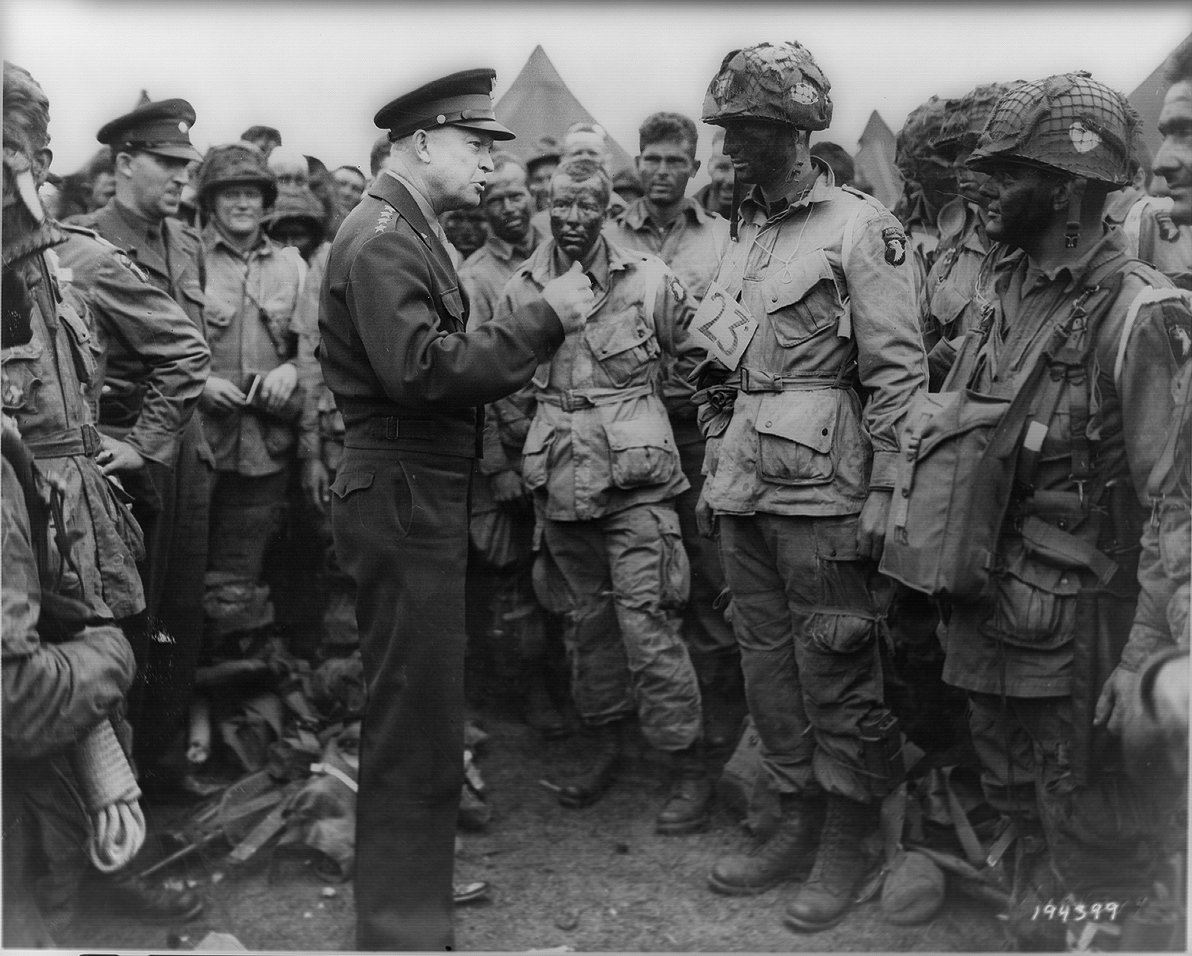
In the run up to D-Day in June 1944, Eisenhower was under unbelievable strain. As Supreme Commander of the Allied Expeditionary Force, the success or failure of the largest landing in military history would rest on the Kansan's broad shoulders. In his wonderful book The Guns at Last Light, Rick Atkinson reveals that Ike wasn't sleeping much, was smoking up to 80 Camel cigarettes a day and, as a result, couldn't shake the throat and respiratory infections that'd bothered him for months.
2014-10-10-Eisenhower_dday.jpg
Though the 156,000 British, American and Canadian troops who stormed the beaches of Normandy endured heavy losses, they eventually prevailed and less than a year later, Hitler's would-be empire lay in ruins. Lauded as the mastermind of D-Day, Eisenhower served as military governor of the US Occupied Zone in Germany and then as US Army Chief of Staff. When he retired from military service in 1948, the five star General understandably wanted a quieter life away from the gaze of an adoring public, and thought he'd be getting one as the President of Columbia University.
This new, sedate role in academia have been enough for Eisenhower, but many Americans wanted their beloved war hero to pursue a different and more prestigious Presidency - one that would see him in the White House.
One of the many criticisms - a lot of them unfair - of Harry Truman was that he had little political experience before ascending to the highest office in the land after FDR's death in April 1945. He had only been Vice President 82 days, and had been in the Senate for nine years before Roosevelt chose him as his unlikely running mate - a short track record in Washington compared to other heirs apparent. Yet while Eisenhower had proved his political skill in working with Allied governments and tempestuous military figures like General George Patton, he had no background walking the corridors of power. So like his fellow Midwesterner Truman, who was from Missouri, Eisenhower was hardly a classic candidate for President.
This didn't deter the Republicans and Democrats from courting him in 1948. Before they nominated Dewey, the GOP figured that Ike could help them win an election for the first time since Herbert Hoover's victory in 1928. When he rebuffed them, the Democrats took their turn at persuading Ike to run in place of Truman, whose reputation still paled in comparison to that of his predecessor and who almost everyone - including First Lady Bess Truman - thought would lose come November. FDR's son James Roosevelt, tried to bring his family name and position of influence with California's Democratic organization to bear on Eisenhower. Powerful party men like New York mayor William O'Dwyer and Frank Hague of Jersey City then started petitioning the General. And labor chiefs Phil Murray of the CIO and Walter Reuther of the United Auto Workers, whose endorsements would guide millions of blue collar voters, also joined the call of duty.
It wasn't just establishment figures who wanted Ike to knock Truman aside, but also the youthful and increasingly popular Americans for Democratic Action (ADA). In June, another son of FDR, Elliot, drew cheers from an ADA rally in New York when he read a non-committal letter from Eisenhower that stated, "I am anxious to do my duty, but felt that it was my own problem to determine whether a sense of duty could call me into the political field." Though this was hardly a notice of acceptance, the ADA faithful drew hope from the fact that it wasn't a denial, either.
A month later, as delegates converged to select the Democratic Party candidate, ADA volunteers handed out hundreds of "I Like Ike" buttons. It seemed from the groundswell of sentiment in Philadelphia that all Eisenhower needed to do was say "yes" to become the Dem's nominee.

Click here to finish reading this article via the Huffington Post.

Want to order a signed copy of my new book, Whistle Stop: How 31,000 Miles of Train Travel, 352 Speeches, and a Little Midwest Gumption Saved the Presidency of Harry Truman? Then e-mail me or leave a comment on this post and I'll make it happen.

Friday, October 10, 2014

2014 Midterm Election's Billion Dollar Budget vs Harry Truman's 1948 Whistle Stop Shoestring

One billion dollars. That's how much candidates for the upcoming US midterm elections have raised for their House and Senate campaigns. A billion freaking dollars! And actually, according to figures released by the FEC and shared by Opensecrets.org, that's rounding down. With more than six weeks to go until election night, the total might jump up to $1.5 billion. That's what it takes to take candidates around their states in nice air conditioned RVs and private planes, and, of course, to film horrendous TV promos (though they'll be hard pressed to beat Jeff Wagner's ad from the 2013 Minneapolis mayoral race). In the 2012 Presidential election, Barack Obama and Mitt Romney spent almost $2 billion.
Rewind to 1948, before the days of super PACs, TV debates and, well, shirtless guys climbing out of lakes to drink coffee, and you'd find a completely different campaign cycle. Nobody likes to back a loser, and that's just what most journalists, politicos and pollsters thought President Harry Truman would be come election night.
2014-09-25-WildaboutHarry.jpg
Thrust into the White House by the untimely demise of Franklin Roosevelt two years before, Truman had helped the Allies win the war in the Pacific with a decision no leader should have to make. Then he squared his shoulders as peacetime problems marched toward him, overcoming millions of workdays lost to strikes and taking two giant steps forward in civil rights by ending pay discrimination for federal employees and desegregating the US Armed Forces.
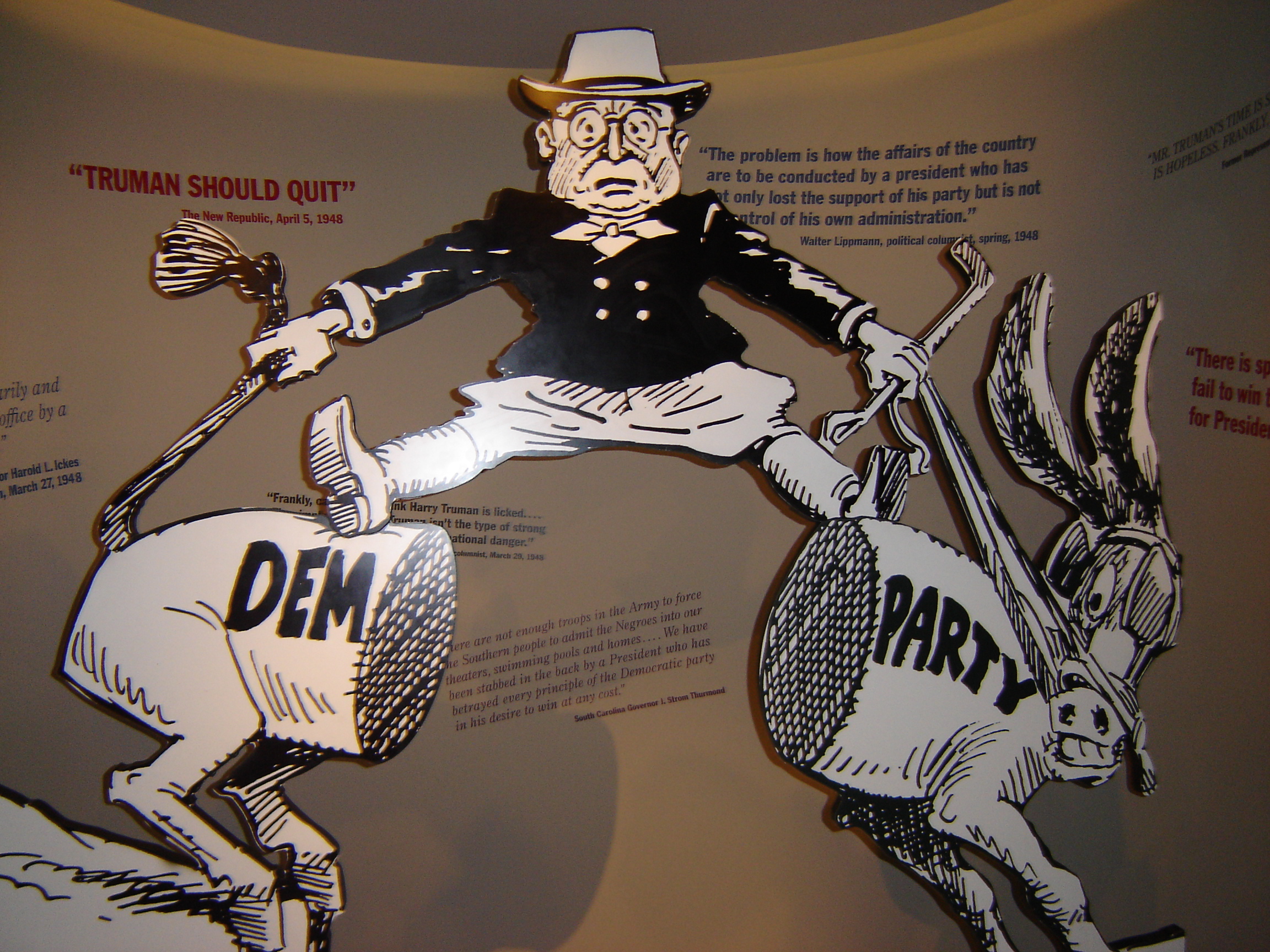
And yet the Southern Democrats (aka Dixiecrats) had broken away in protest of this civil rights program, rallying around J. Strom Thurmond, the fiery former Governor of South Carolina who declared that "there's not enough troops in the Army to break down segregation." The Democratic Party also split to the left, with former Vice President Henry Wallace calling for a conciliatory stance toward Soviet Russia and nationalized industries as leader of the Progressive Party.
2014-09-25-DeweyWhiteHouseAssoffGrass.jpg
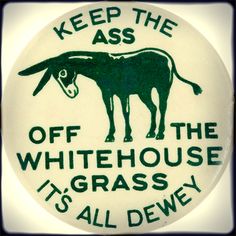
Meanwhile, the Republicans, out of power since FDR won the 1932 election, believed they would recapture the White House by putting debonair former New York Governor Thomas E. Dewey - who'd come closest of all GOP candidates to defeating FDR - and likable California Governor Earl Warren on a "dream ticket" that had the media fawning. In fact, more than two thirds of editors surveyed midway through the campaign believed Truman was done, a verdict backed up by Dewey's double digit polling leads.
So how bad did things get for Truman's finance team? Well, the President clambered on top of a chair at a White House fundraiser, and pleaded for contributions from a room of wealthy backers: "I am appealing for your help. Help to carry my message to the American people. We just haven't got the money to buy radio time. In Detroit on Labor Day we had to cut out one of the most important sections of my speech because we didn't have the money to stay on the air." The Chief Executive was certainly being truthful: despite Oklahoma Governor Roy Turner cutting a last minute check to radio networks so they'd broadcast Truman's Cadillac Square address, Truman had to edit his concluding remarks. But climbing on a chair to beg wasn't Presidential, his detractors scoffed, with Drew Pearson lamenting in his daily 'Washington Merry Go-Round' column that Truman looked "pathetic and alone."
The chair-top appeal did convince some donors to cough up, including two who gave $10,000 a piece on the spot. But the money didn't get the President very far, literally or figuratively. As his train car, the armor-plated Ferdinand Magellan, chugged into Oklahoma in the final days of September, Truman had reached the end of the line. Hearing that the Democratic National Committee was hard up, the railroads took a page from the radio network's playbook, demanding up front payment for fuel and other fees. The trouble was, the coffers were empty. For Truman to continue on his 31,000 mile Whistle Stop Tour that he had started in June and complete the rest of the planned 352 speeches (he gave up to 16 a day), it looked like he'd need an act of God.

Click here to read the rest of the post at The Huffington Post.

And don't forget to click here to pre-order your copy of Whistle Stop: How 31,000 Miles of Train Travel, 352 Speeches, and a Little Midwest Gumption Saved the Presidency of Harry Truman.

Want to buy a signed copy? Then e-mail me today and we'll figure it out.

Thursday, July 10, 2014

I Hear That Train A-Comin': Cameron Should Follow Truman's Whistle Stop Lead With Early Campaigning

It appears from recent statements in the House of Commons and from Downing Street that the only vote David Cameron is concerned about is the Scottish independence referendum. While it's certainly an important matter that will help decide the future of the UK, Cameron should also be thinking about voters in another election battle: his own. While the next General Election is 10 months away, looking to the example of Harry Truman's 1948 Whistle Stop campaign as an example of how an embattled leader can get his message out to the electorate well before they head to the polls.
This time in 1948 was not kind to President Harry Truman. The Soviet Union started the Berlin Blockade, which cut off food, coal, medical supplies and all other road, rail and river traffic to East Berlin. The Communist takeover of China continued, while Communist forces also threatened to depose the Greek ruling party.
Things were little better back in the US. Franklin Roosevelt's former Vice President Henry Wallace leading a left-leaning breakaway of the Democratic Party on one of Truman's flanks, while the Southern Democrats (aka Dixiecrats') used the issue of states' rights to mask their racism as they too broke away from Truman because he supported civil rights. Later that year the States' Rights Democratic Party leader, Strom Thurmond, would outrageously declare that "there's not enough troops in the army to force the southern people to break down segregation and admit the nigger race into our swimming pools, our homes, and into our churches."
Truman could have waited until the autumn to launch his bid to beat Thurmond, Wallace and Republican candidate Thomas Dewey. After all, by mid October in his final election cycle, his predecessor, FDR, had only given two major speeches. But Truman was not beloved by the party faithful as Roosevelt had been, and wartime unity was a thing of the past. So the President used a speaking engagement at the University of California's Berkeley campus as an excuse to go on a "non-political inspection tour" of the Western United States. In fact, this "Shakedown Cruise" as one member of his new Research Division called it, certainly was political, with its aim being for Truman to share the main concepts of the Democratic platform from as many train platforms as possible.
Heading out in mid June, Truman's train rumbled across thousands of miles of track - 9,505, to be precise. He delivered 76 speeches in 18 states in just 15 days and while some of those were to large audiences, most were to small groups who had gathered at train stations in small towns. Truman would come out to the rear platform of his armor-plated living quarters - which included a bedroom, kitchen, bathroom and formal dining room - speak for a few minutes, shake a few hands, and then head on down the line.
During these brief speeches, Truman discussed conservation, reclamation and power projects in the West, the precarious situation in Germany, provision of low cost housing and government support for farmers. But he saved his most energetic words for the Republican-controlled 80th Congress, which he felt had blocked all of his party's major legislation just for the sake of obstruction. He warned that if people voted the same way as they had in the 1946 midterm elections, they would get more of the same inaction from another "do nothing Congress", which he claimed was "the worst we've ever had" (today's Democrats may have something to say about that.) Insulted, the man who many felt controlled that Congress, Ohio's Robert Taft (the son of former President William Howard Taft), complained that Truman was "blackguarding Congress at every whistle stop in the West." Rather than firing back at the man whose motto was "The duty of opposition is to oppose," the wily Truman embraced the "Whistle Stop" slogan, and took advantage of the outrage from the small towns he spoke in, whose residents were offended by Taft dismissing them as inconsequential.
Click here to keep reading this article via The Huffington Post. 
Want the full story of Truman's Whistle Stop Tour and remarkable 1948 election victory? 
Then Click here to buy the US version of my new book, Whistle Stop: How 31,000 Miles of Train Travel, 352 Speeches, and a Little Midwest Gumption Saved the Presidency of Harry Truman. 
Live in the UK/Europe? Then click here to get a copy.  
If you'd like a signed copy (to be dispatched in early November 2014) please e-mail me

Tuesday, July 8, 2014

Harry Truman and the RAF Save West Berlin: Remembering the Airlift that Defied Communism

The fight for freedom in Europe did not end with the defeat of Adolf Hitler's Germany at the end of World War 2. As Winston Churchill correctly stated in his Sinews of Peace address (aka 'The Iron Curtain Speech') at Fulton, Missouri in 1946, Communism was the next great threat to democracy. And for Berliners in 1948, the tension between totalitarianism and democracy was at their doorstep, as Soviet Russia attempted to force French, British and American troops to quit the city of ruins so Communism could fill the void left by Fuhrer's fall.
In June 1948, Harry Truman was fighting for his political life. His party was split two ways - with Henry Wallace's Progressives veering to the far left, even as a bloc of Southern Democrats (aka the Dixiecrats) cried foul over Truman's bold civil rights proposals. Soon enough, the Republican Party would put forth a 'dream ticket' of Thomas Dewey, the New York Governor who had come closest of all GOP candidates to defeating FDR, and popular California Governor Earl Warren. American commentators gave Truman little chance, while Clare Boothe Luce, wife of Time proprietor Henry Luce, declared that the Man from Missouri was a "gone goose."
But Truman refused to accept that his goose was about to be cooked. He set off on a 9,000 mile train tour in the West which saw him speak to hundreds of thousands of Americans. This led to Truman's nemesis, Republican Senator Robert Taft, grumbling that Truman was "blackguarding Congress at every whistle stop." Rather than bristling at Taft's comment, Truman embraced it and now his campaign had a name - The Whistle Stop Tour.
So the President had plenty of domestic matters to occupy his mind as he concluded his Western 'non political' jaunt - which was, in fact, very political! - and returned to Washington DC. But he had to set inter-party fighting and his continued conflict with the Republican-controlled "do-nothing Congress" aside when disturbing news came through from Germany. In response to West Berlin issuing its own currency - a sign of fiscal freedom that Moscow fretted would spread into its tightly controlled zone - the Soviets had cut off road, rail and river traffic between Allied zones and the Red Army-occupied zone. This meant that the food, coal and medical supplies West Berliners needed to survive couldn't get through. It was clearly a Russian power play designed to force America and her partners to either abandon their efforts to restore democracy and a free economy in Berlin, or to quit the city altogether. If this happened, Stalin and his cronies would have a free hand and could fill the void left by Nazism with Communism, and the Cold War would've taken a decisive turn in Soviet Russia's favor.
Truman refused to yield. Taking advice from his military commanders and civilian advisors on the ground, he approved one of the biggest airborne relief campaigns in history: The Berlin Airlift. With all other transport routes cut off, American and British planes took to the skies over Berlin, delivering essentials to West Berliners and calling Stalin's bluff. Some aircraft also dropped sweets and as a result were soon dubbed "The Candy Bombers."

Click here to finish reading this story via The Huffington Post.

Want the full story of Truman's Whistle Stop Tour and remarkable 1948 election victory? 
Then Click here to buy the US version of my new book, Whistle Stop: How 31,000 Miles of Train Travel, 352 Speeches, and a Little Midwest Gumption Saved the Presidency of Harry Truman. 
Live in the UK/Europe? Then click here to get a copy.  
If you'd like a signed copy (to be dispatched in early November 2014) please leave a comment on this blog post and I'll get back to you.

Tuesday, July 9, 2013

Finishing a Book: Ditch the Ego, Act on the Criticism, Pick the Hills to Die On

Well, I’ve done it, and I’m pretty pleased with myself. I finally finished the remaining three chapters of my next book (Whistle Stop: How 31,000 Miles, 352 Speeches and 6 Bright Young Men Saved the Presidency of Harry Truman, due fall 2014 - watch this space). Well, kinda. In fact, what I really did was send the rest of the first draft to the two generous souls who are reviewing my manuscript. 

Now for the fun part. And by fun, I mean death-to-the-ego-and-all-my-hopes-and-dreams. Unfortunately for me, some editors just want to watch the world burn

You see, soon enough my inbox will light up with e-mails, containing page after page of edit afflicted prose. And with each new comment, redline and question, I will die a little. Or at least my ego will. 

In a perfect, pain-free world, writers could just churn out a bunch of words, revise them ourselves and then fling them out to the unsuspecting public. Oh, wait, we can. I keep forgetting about self-publishing. 

But alas, those of us who go the traditional route of talking an academic or trade press into publishing our portable monuments to how smart we think we are, are resigned to several months of editorial torture that we willingly brought upon ourselves. 

Here are a few tips to get you through the process:

Accept That You’re Too Close

The trouble with you editing, re-editing, and re-re-editing your manuscript is that you’re wed to it. You breathe it. It wakes you up at odd times of the night, then scolds you for forgetting to put your tablet/notepad & pen beside the bed, you clot. No matter how objective you think you’re being, believe me, you’re not. That’s why you asked those poor saps to read it through with a wary eye and a warning finger before you subjected your editor to the horrors of a hundred thousand unbalanced, repeated, bloated words. 

Click here to read the rest of this post via the blog of Boston University's The Historical Society. 

Thursday, April 11, 2013

Truman, Thatcher and Right to Work - A Legacy of Political Resolve

So much has been written about the late, great Margaret Thatcher this week that if you found this blog post via a search engine, I applaud your diligence! (and good evening to my regular readers). It's hard to encapsulate Thatcher's legacy in a single blog post, but here's one ex-pat Brit's attempt to write something new:

Before we get to The Grocer's Daughter, let's look in on 1945. In April of that year, Harry Truman, who had Vice President for just 82 days, took FDR's place in the White House. When he asked a grieving Eleanor Roosevelt if he could help in any way, she told him “Is there anything we can do for you? For you are the one in trouble now."

How right she was. Though Truman faced Communist expansionism abroad and made the tough decision to drop two atomic bombs on Japan, he had a host of problems at home. The doubts of the liberals who doubted his commitment to the progressive cause, threats of the Southern Democrats who despised his pro-civil rights stance and look-down-the-nose derision of the FDR loyalists who thought him an uneducated commoner were the least of them.

At the top of the list was labor unrest. Once the war was over, the AFL, CIO, UMW and other big unions wanted payback for their wartime efforts and for frozen wage increases. Their foils, the titans of industry, refused to meet these demands, and so the picketing began. Steel workers, miners, auto workers and more refused to man their posts, and all told 28.5 million work days were lost, the highest total in US history.

Truman called in A.F. Whitney, chief of the Brotherhood of Railway Trainmen, and Alvanley Johnston, head of the largest railway engineers' union, insisted that they put a stop to the strikes. They refused. "All right," the President told them. "I'm going to give you the gun."

And he did. Though Truman's negotiators brokered a settlement while he was at the podium, Truman told a joint session that he wanted power to draft the striking trainmen into the US Army. They'd have to obey their Commander in Chief, he reasoned. Though Truman later healed his rift with most union leaders and secured crucial labor backing to fuel his unlikely 1948 election win, he would not be held hostage by union chiefs, even when his opposition risked their wrath.

Fast forward to the late 1970s. Now it was Britain that was at the mercy of the trade unions, which provided funds for the ruling Labour Party and so had carte blanche at 10 Downing Street during the shaky Labour tenure of Harold Wilson and James Callaghan. Unlike Truman, these two men lacked the fortitude to say "no" to their backers, and so the Communist-influenced unions got exactly what they wanted.

Until Maggie. When she took over from Callaghan in May 1979, the union chiefs must have thought it'd be business as usual, even though she was a Conservative instead of a leftist puppet. When it became clear that the new Prime Minister wouldn't be intimidated by threats, the National Mine Workers strikes started, led by the fiery Marxist Arthur Scargill, who was determined to destroy Thatcher's government as his organization had Edward Heath's Tory administration in 1974.

But they underestimated the grit of the Iron Lady. She told the Conservative Party's 1922 Committee during the peak of 1984-1985 strikes: "We had to fight the enemy without in the Falklands. We always have to be aware of the enemy within, which is much more difficult to fight and more dangerous to liberty."

Despite the difficulty and danger of the situation, during which strikers battled riot police and Scargill disgraced his movement by failing to bring the Government's settlement offer before his workers (see this brilliant book), Thatcher prevailed. The type of strike that saw unions punish industrial suppliers was banned and the striking workers failed to bring the nation to its knees. Which was Scargill's aim all along. In the ensuing years, the British economy awakened from its late-70's slumber and ceased to be "sick man of Europe" (or, indeed, woman!).

And who is carrying the leadership torch of Truman and Thatcher today? None other than the bold state governors of the United States. Recognizing that people like Scargill and current UAW president Bob King are not defenders of workers' rights but rather the living embodiment of the "some are more equal than others" mentality of the ruling elite in Orwell's Animal Farm, Rick Snyder, Mitch Daniels and the governors of 22 other states have passed "right to work" legislation. Combined with bold tax cuts, such as those recently passed by Kansas governor Sam Brownback, such moves are spurring economic growth that's impossible in union-dominated states. No wonder so many people are relocating to low-tax areas.

For the good of taxpayers and business alike, unions cannot be allowed to hold the whip hand. To prevent this, the US President, British Prime Minister and American governors should channel the resolve, determination and courage of the grocer's daughter and the farmer's son: a Conservative and a Democrat who strode boldly where others feared to tread.


Sunday, March 24, 2013

Budget BS: The Sequester Hits History

When we think about the budget mess in Washington, it’s easy to focus on how it affects what’s now and what’s next. But what’s often overlooked is how budget cuts impact the study of the past. Or, how those cuts might shape history for current and future generations.

Harry S. Truman's farm home in Grandview, Missouri
In the past year, I’ve spent many a Saturday morning at the Harry S. Truman Museum and Library in Independence, Mo., merrily panning for research gold sifting through umpteen boxes and folders. Thankfully the museum and the researcher’s reading room/library will not be closing.

But as of March 24, Truman’s old white-board home in Independence (which he far preferred to the other White House he lived in, dubbing the latter, “the great white jail”) will be closed on national holidays, Sundays and Mondays. The Noland house across the street, which once belonged to Truman’s cousins, is being shuttered for good. And though visitors can still mosey around the grounds of the family farm in Grandview, Missouri, they’ll no longer be able to tour the house.

Click here to read the rest of this post on the blog of Boston University's The Historical Society.

And if you can, take a trip to the Truman Library and Museum. It's well worth it for anyone interested in the man who is, I'll wager, the most underrated US President. In the meantime, you could check out their website.

Saturday, March 9, 2013

Winston Churchill's Iron Curtain Speech: Still Relevant, 67 Years On


This week marks the 67th anniversary of Winston Churchill's 'Iron Curtain' address (actually named 'The Sinews of Peace'), which he called "the most important speech of my career". And he'd given one or two of those.
Churchill's speech in the unlikely venue of Westminster College in Fulton, Missouri, was panned at the time for blasting Soviet Russia, whom many in Britain and the US still considered an ally, for warning of the potential of World War Three and for calling out the divisions between the Communist East and democratic West. Of course, Churchill's illustration of the "iron curtain" (a term he made popular but did not invent) was later embodied in the defining symbol of the Cold War - the Berlin Wall. And you can hardly watch a news broadcast on foreign affairs without hearing Churchill's term for the bond between the US and the British Commonwealth, the "special relationship" (though quite how "special" it is right now is debatable.)


But is the speech still worth listening to and reading about, all these years later? After all, we'll be celebrating the 25th anniversary of the Berlin Wall next year and though Communism remains a force, it is hardly the global menace that Churchill spoke of. Despite these facts, I believe Churchill's "most important" speech should indeed be studied, and not merely as a historical relic. Here are a few reasons why:
1) Leadership 

When he spoke in Fulton in March 1946, Churchill was no longer Prime Minister. The Conservative Party was punished for things that happened before Winston became head of a coalition government - not least the appeasement of Baldwin and Chamberlain and the poor standard of living many Britons had during their tenure. While the Tories campaigned on the strength of Churchill's war leadership, the Labour Party looked forward, creating a manifesto that addressed the postwar housing shortage, rebuilding wartime damage and, for good or for ill, extending socialized medicine.
But though he had lost his post of prime minister, Churchill's role of statesman was not over. He recognized that his stark warning about Communism would be unpopular, as did Harry Truman, who later disingenuously denied reading the speech before Churchill delivered it.
Yet Churchill recognized that to truly lead you must be willing to risk unpopularity, even ridicule, to tell hard truths. And what he said at Fulton - about the perils of expansionist Communism, about the need for the US, Britain and the rest of the English-speaking peoples to stand together in good times and in ill - was certainly truth. As predicted, Churchill was derided as an imperialist, an old Tory, and, by Stalin himself, as a warmonger. And yet, after braving hundreds of protesters yelling "GI Joe is home to stay, Winnie, Winnie, go away" to give another bold speech days later at New York's Waldorf Astoria hotel, Churchill stood his ground, stating that "I do not wish to withdraw or modify a single word."


Click here to read the rest of this article via the Huffington Post.

Monday, March 4, 2013

This Week Only: Get Signed Copy Of Our Supreme Task (story of Churchill's Iron Curtain Speech) for $10 + Postage

To celebrate the paperback release of Our Supreme Task - the story behind Winston Churchill's Iron Curtain speech and visit to Fulton, MO - I'n offering signed copies for just $10 + postage this week to anyone in the US.

If you'd like a signed hardback, just leave a comment on this blog post with your e-mail address and I will contact you to setup payment and delivery. If you have a problem with the comments (curse you, internet!), just e-mail me at alionintheheartland@gmail.com.

Copies are limited so don't delay.