Friday, October 10, 2014

2014 Midterm Election's Billion Dollar Budget vs Harry Truman's 1948 Whistle Stop Shoestring

One billion dollars. That's how much candidates for the upcoming US midterm elections have raised for their House and Senate campaigns. A billion freaking dollars! And actually, according to figures released by the FEC and shared by Opensecrets.org, that's rounding down. With more than six weeks to go until election night, the total might jump up to $1.5 billion. That's what it takes to take candidates around their states in nice air conditioned RVs and private planes, and, of course, to film horrendous TV promos (though they'll be hard pressed to beat Jeff Wagner's ad from the 2013 Minneapolis mayoral race). In the 2012 Presidential election, Barack Obama and Mitt Romney spent almost $2 billion.
Rewind to 1948, before the days of super PACs, TV debates and, well, shirtless guys climbing out of lakes to drink coffee, and you'd find a completely different campaign cycle. Nobody likes to back a loser, and that's just what most journalists, politicos and pollsters thought President Harry Truman would be come election night.
2014-09-25-WildaboutHarry.jpg
Thrust into the White House by the untimely demise of Franklin Roosevelt two years before, Truman had helped the Allies win the war in the Pacific with a decision no leader should have to make. Then he squared his shoulders as peacetime problems marched toward him, overcoming millions of workdays lost to strikes and taking two giant steps forward in civil rights by ending pay discrimination for federal employees and desegregating the US Armed Forces.
And yet the Southern Democrats (aka Dixiecrats) had broken away in protest of this civil rights program, rallying around J. Strom Thurmond, the fiery former Governor of South Carolina who declared that "there's not enough troops in the Army to break down segregation." The Democratic Party also split to the left, with former Vice President Henry Wallace calling for a conciliatory stance toward Soviet Russia and nationalized industries as leader of the Progressive Party.
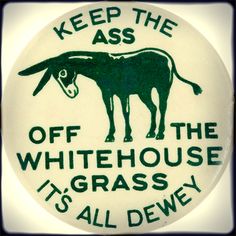
2014-09-25-DeweyWhiteHouseAssoffGrass.jpg
Meanwhile, the Republicans, out of power since FDR won the 1932 election, believed they would recapture the White House by putting debonair former New York Governor Thomas E. Dewey - who'd come closest of all GOP candidates to defeating FDR - and likable California Governor Earl Warren on a "dream ticket" that had the media fawning. In fact, more than two thirds of editors surveyed midway through the campaign believed Truman was done, a verdict backed up by Dewey's double digit polling leads.
So how bad did things get for Truman's finance team? Well, the President clambered on top of a chair at a White House fundraiser, and pleaded for contributions from a room of wealthy backers: "I am appealing for your help. Help to carry my message to the American people. We just haven't got the money to buy radio time. In Detroit on Labor Day we had to cut out one of the most important sections of my speech because we didn't have the money to stay on the air." The Chief Executive was certainly being truthful: despite Oklahoma Governor Roy Turner cutting a last minute check to radio networks so they'd broadcast Truman's Cadillac Square address, Truman had to edit his concluding remarks. But climbing on a chair to beg wasn't Presidential, his detractors scoffed, with Drew Pearson lamenting in his daily 'Washington Merry Go-Round' column that Truman looked "pathetic and alone."
The chair-top appeal did convince some donors to cough up, including two who gave $10,000 a piece on the spot. But the money didn't get the President very far, literally or figuratively. As his train car, the armor-plated Ferdinand Magellan, chugged into Oklahoma in the final days of September, Truman had reached the end of the line. Hearing that the Democratic National Committee was hard up, the railroads took a page from the radio network's playbook, demanding up front payment for fuel and other fees. The trouble was, the coffers were empty. For Truman to continue on his 31,000 mile Whistle Stop Tour that he had started in June and complete the rest of the planned 352 speeches (he gave up to 16 a day), it looked like he'd need an act of God.

Click here to read the rest of the post at The Huffington Post.

And don't forget to click here to pre-order your copy of Whistle Stop: How 31,000 Miles of Train Travel, 352 Speeches, and a Little Midwest Gumption Saved the Presidency of Harry Truman.

Want to buy a signed copy? Then e-mail me today and we'll figure it out.

Thursday, July 10, 2014

I Hear That Train A-Comin': Cameron Should Follow Truman's Whistle Stop Lead With Early Campaigning

It appears from recent statements in the House of Commons and from Downing Street that the only vote David Cameron is concerned about is the Scottish independence referendum. While it's certainly an important matter that will help decide the future of the UK, Cameron should also be thinking about voters in another election battle: his own. While the next General Election is 10 months away, looking to the example of Harry Truman's 1948 Whistle Stop campaign as an example of how an embattled leader can get his message out to the electorate well before they head to the polls.
This time in 1948 was not kind to President Harry Truman. The Soviet Union started the Berlin Blockade, which cut off food, coal, medical supplies and all other road, rail and river traffic to East Berlin. The Communist takeover of China continued, while Communist forces also threatened to depose the Greek ruling party.
Things were little better back in the US. Franklin Roosevelt's former Vice President Henry Wallace leading a left-leaning breakaway of the Democratic Party on one of Truman's flanks, while the Southern Democrats (aka Dixiecrats') used the issue of states' rights to mask their racism as they too broke away from Truman because he supported civil rights. Later that year the States' Rights Democratic Party leader, Strom Thurmond, would outrageously declare that "there's not enough troops in the army to force the southern people to break down segregation and admit the nigger race into our swimming pools, our homes, and into our churches."
Truman could have waited until the autumn to launch his bid to beat Thurmond, Wallace and Republican candidate Thomas Dewey. After all, by mid October in his final election cycle, his predecessor, FDR, had only given two major speeches. But Truman was not beloved by the party faithful as Roosevelt had been, and wartime unity was a thing of the past. So the President used a speaking engagement at the University of California's Berkeley campus as an excuse to go on a "non-political inspection tour" of the Western United States. In fact, this "Shakedown Cruise" as one member of his new Research Division called it, certainly was political, with its aim being for Truman to share the main concepts of the Democratic platform from as many train platforms as possible.
Heading out in mid June, Truman's train rumbled across thousands of miles of track - 9,505, to be precise. He delivered 76 speeches in 18 states in just 15 days and while some of those were to large audiences, most were to small groups who had gathered at train stations in small towns. Truman would come out to the rear platform of his armor-plated living quarters - which included a bedroom, kitchen, bathroom and formal dining room - speak for a few minutes, shake a few hands, and then head on down the line.
During these brief speeches, Truman discussed conservation, reclamation and power projects in the West, the precarious situation in Germany, provision of low cost housing and government support for farmers. But he saved his most energetic words for the Republican-controlled 80th Congress, which he felt had blocked all of his party's major legislation just for the sake of obstruction. He warned that if people voted the same way as they had in the 1946 midterm elections, they would get more of the same inaction from another "do nothing Congress", which he claimed was "the worst we've ever had" (today's Democrats may have something to say about that.) Insulted, the man who many felt controlled that Congress, Ohio's Robert Taft (the son of former President William Howard Taft), complained that Truman was "blackguarding Congress at every whistle stop in the West." Rather than firing back at the man whose motto was "The duty of opposition is to oppose," the wily Truman embraced the "Whistle Stop" slogan, and took advantage of the outrage from the small towns he spoke in, whose residents were offended by Taft dismissing them as inconsequential.
Click here to keep reading this article via The Huffington Post. 
Want the full story of Truman's Whistle Stop Tour and remarkable 1948 election victory? 
Then Click here to buy the US version of my new book, Whistle Stop: How 31,000 Miles of Train Travel, 352 Speeches, and a Little Midwest Gumption Saved the Presidency of Harry Truman. 
Live in the UK/Europe? Then click here to get a copy.  
If you'd like a signed copy (to be dispatched in early November 2014) please e-mail me. 

Tuesday, July 8, 2014

Harry Truman and the RAF Save West Berlin: Remembering the Airlift that Defied Communism

The fight for freedom in Europe did not end with the defeat of Adolf Hitler's Germany at the end of World War 2. As Winston Churchill correctly stated in his Sinews of Peace address (aka 'The Iron Curtain Speech') at Fulton, Missouri in 1946, Communism was the next great threat to democracy. And for Berliners in 1948, the tension between totalitarianism and democracy was at their doorstep, as Soviet Russia attempted to force French, British and American troops to quit the city of ruins so Communism could fill the void left by Fuhrer's fall.
In June 1948, Harry Truman was fighting for his political life. His party was split two ways - with Henry Wallace's Progressives veering to the far left, even as a bloc of Southern Democrats (aka the Dixiecrats) cried foul over Truman's bold civil rights proposals. Soon enough, the Republican Party would put forth a 'dream ticket' of Thomas Dewey, the New York Governor who had come closest of all GOP candidates to defeating FDR, and popular California Governor Earl Warren. American commentators gave Truman little chance, while Clare Boothe Luce, wife of Time proprietor Henry Luce, declared that the Man from Missouri was a "gone goose."
But Truman refused to accept that his goose was about to be cooked. He set off on a 9,000 mile train tour in the West which saw him speak to hundreds of thousands of Americans. This led to Truman's nemesis, Republican Senator Robert Taft, grumbling that Truman was "blackguarding Congress at every whistle stop." Rather than bristling at Taft's comment, Truman embraced it and now his campaign had a name - The Whistle Stop Tour.
So the President had plenty of domestic matters to occupy his mind as he concluded his Western 'non political' jaunt - which was, in fact, very political! - and returned to Washington DC. But he had to set inter-party fighting and his continued conflict with the Republican-controlled "do-nothing Congress" aside when disturbing news came through from Germany. In response to West Berlin issuing its own currency - a sign of fiscal freedom that Moscow fretted would spread into its tightly controlled zone - the Soviets had cut off road, rail and river traffic between Allied zones and the Red Army-occupied zone. This meant that the food, coal and medical supplies West Berliners needed to survive couldn't get through. It was clearly a Russian power play designed to force America and her partners to either abandon their efforts to restore democracy and a free economy in Berlin, or to quit the city altogether. If this happened, Stalin and his cronies would have a free hand and could fill the void left by Nazism with Communism, and the Cold War would've taken a decisive turn in Soviet Russia's favor.
Truman refused to yield. Taking advice from his military commanders and civilian advisors on the ground, he approved one of the biggest airborne relief campaigns in history: The Berlin Airlift. With all other transport routes cut off, American and British planes took to the skies over Berlin, delivering essentials to West Berliners and calling Stalin's bluff. Some aircraft also dropped sweets and as a result were soon dubbed "The Candy Bombers."

Click here to finish reading this story via The Huffington Post.

Want the full story of Truman's Whistle Stop Tour and remarkable 1948 election victory? 
Then Click here to buy the US version of my new book, Whistle Stop: How 31,000 Miles of Train Travel, 352 Speeches, and a Little Midwest Gumption Saved the Presidency of Harry Truman. 
Live in the UK/Europe? Then click here to get a copy.  
If you'd like a signed copy (to be dispatched in early November 2014) please leave a comment on this blog post and I'll get back to you.

Friday, July 4, 2014

Big Wave Surfer Dave Kalama, CrossFit Athletes, Walkers Sweat for Cystic Fibrosis

When siblings Audrey and Jack DuCharme are healthy, they need a breathing treatment each day. Then there's the multiple inhaled medications, the doctors' checkups, and the fear that if they get a cold - which most of us would dismiss as a sniffle - it could put them in hospital, or at least require four daily treatments. This routine would be hard enough for an adult. Audrey is seven and Jack is five.


They're two of the 30,000 young people in the US who suffer from cystic fibrosis (CF), which also affects 10,000 people in the UK. This inherited disease is caused by a gene mutation which causes improper movement of water and salt in and out of cells, leading to mucus clogging the lungs and digestive system. When a CF patient gets bacteria in their lungs, it can be fatal and sometimes only a lung transplant can extend their life. CF can also lead to heart disease, diabetes and a host of other difficulties.
This month saw a host of fundraising events to raise money and awareness for CF. Big wave surfer Dave Kalama, who with Laird Hamilton pioneered tow surfing at Peahi (Jaws) and popularized standup paddleboarding, serves on the board for Pipeline to a Cure (as does Hamilton).
"With all the ocean has given me as a surfer, how can you not want to share and give back to such a worthy cause, that is so directly beneficial to people with cystic fibrosis?" Kalama said.
In a recent motivational talk for racers at the prestigious Carolina Cup standup paddleboard race, Kalama shared his worst race experience, when an illness soon before the 2009 Molokai race left him uncharacteristically underprepared and wanting to stop partway through the event. As shown, the video below, it was the thought of the CF kids who his charity work benefits that kept Kalama going, resolved that "you never, ever quit."

It's not only surfers who are standing up for CF sufferers. At Solution One CrossFit in Shawnee, Kansas, owner JR Kuchta and longtime member Jeremy Snyder organized a "CF for CF" event, which 3-time CrossFit Games champion Rich Froning helped promote by tweeting about it.
During the special charity WOD, CrossFitters paid $10 and then completed as many rounds of 50 air squats, 30 pushups and 15 pullups as they could in 12 minutes. As the athletes went through their paces earlier this month, Audrey and Jack DuCharme watched with their parents, Jim and Stephanie.
"It's great to see new families joining in to raise money for the Cystic Fibrosis Foundation each year," Stephanie said. "We're so thankful for everyone's support, which is raising the profile of CF and prompting drug companies to come up with better treatments that have raised life expectancy from 34 to 41 in the past 10 years."
Click here to finish reading this story via The Huffington Post. 


Thursday, March 6, 2014

Winston Churchill, Putin's Russia and Ukraine: Timeless Lessons from the 'Iron Curtain Speech' 68 Years On

Can a speech made by a former Prime Minister 68 years ago still be relevant today? When we're talking about Winston Churchill's Sinews of Peace address (aka 'the Iron Curtain speech'), the answer is a resounding "yes."
68 years ago today, Churchill stood in  the crowded Westminster College gymnasium in Fulton, Missouri and shared his concerns about Communism, becoming the first to call out Russia for its takeover of Eastern European nations, which he claimed were becoming little more than puppet police states taking their direction from Moscow.
Churchill was widely condemned for the Fulton address. Labor MPs petitioned Prime Minister Clement Attlee to censure Churchill in the Commons, which he didn't do. Churchill heard the same insults he had endured during his "wilderness" in the 1930s, when his warnings about Hitler earned him labels like "imperialist" and "old Tory." Stalin himself dismissed his former wartime summit partner as a "warmonger." Most people in Britain and the US at the time still saw the Soviet Union as a wartime ally, and many believed that Communism - which they little understood thanks to Russian propaganda - was a viable alternative to democracy. Above all, they would do anything to avoid yet another global conflict. So their derision is understandable, and yet misplaced.
Everything Churchill claimed about the ills of Communism was true, and then some. Beyond the eradication of democracy in Eastern Europe, the Red Army had broken its promises to leave Iran, jeopardizing British and American oil supply and trade (sound familiar?). Stalin demanded military bases in Turkey, and this nation, Greece and China were on the brink of succumbing to Communist takeover. In Korea, the Soviets regularly cut off energy supplies to democratic regions to show who was really in control. Churchill and other leaders were rightly concerned that Communism would fill the void left by Hitler's demise in Germany, and Communist Party membership in Italy and France was rising dramatically. The threat to liberty and freedom was very real, and only Churchill could enunciate it, despite his loss of 10 Downing Street in the calamitous 1946 General Election.
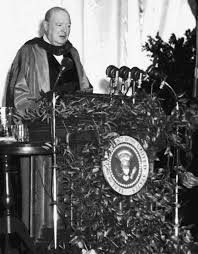
2014-03-05-ChurchillatFulton.jpg
In addition to warning about Russian malfeasance at home and abroad, Churchill suggested how the Western democracies should respond, and what they should avoid. Simply put: strength good, weakness bad. In Churchill's words, "From what I have seen of our Russian friends and Allies during the war, I am convinced that there is nothing they admire so much as strength, and there is nothing for which they have less respect than for weakness, especially military weakness." This was not, as Churchill's critics asserted, a battle cry, but was rather just stating a fact: show weakness and Russia will take advantage. Show strength, and you will earn respect.
Fast forward 68 years and much has changed in Russia since Churchill's wakeup call in Missouri. And yet much remains the same. The so-called "elections" that keep Putin in power (the most recent falling, ironically, on the same date as Churchill's Fulton address) are little more than stagecraftexpertly managed by the ex KGB man's cronies to give the world the false impression that real democracy is reality in Russia. Politicians who oppose the Kremlin are imprisoned or thrown out of (one-horse) political 'races.' Journalists who dare to tell the truth are silenced. Even citizens on foreign soil are not safe if they air a dissenting voice - as Alexander Litvinenko found out to his cost . There is certainly choice in modern Russia - if you choose Putin and his brand of hyper-masculine nationalism, you thrive. If not, you wilt.
So the Cold War may be over, Communism may have receded and Putin may be less of a tyrant than his post-World War II predecessors. But Churchill's words still ring true.

Tuesday, January 28, 2014

Tell It Like It Is, Dave: Cameron Calls Out the EU on Bureaucracy

For most of 2013, David Cameron seemingly couldn't please anyone. The "we want out of Europe" wing of the Conservative Party didn't think he'd done enough, even with the 2017 In/Out referendum pledge, to further their cause. The British economy sputtered like an old engine on a frigid morning. And the Tories slipped up in by-elections that many political commentators viewed as an indictment of Cameron's leadership.
Barely a month into 2014, and Cameron must feel like the storm clouds have finally cleared. Unemployment dropped to 7.1 percent and the number of people out of work fell by 167,000 since November - signs that the UK economy is creating jobs and at last pulling out of its recent slump. Such figures undermine Ed Miliband's vague, unsubstantiated claim that "life's getting harder" for the average Briton.
Certainly, last week's news that the House of Lords has sent the EU Referendum Bill back to the Commons for re-wording is less than ideal. But Cameron has proved his commitment to getting Britain a "better deal" in Europe by pushing the matter and, in practical terms, can do little more to satisfy Euroskeptics at this point.
Well, except maybe continuing to deliver speeches like last week's salvo at the World Economic Forum in Davos. There, Cameron offered re-assurance to his Get-Us-Out supporters that the "fight is not yet won." He then took the EU to task for it's cloying, go-slow bureaucracy, claiming that if Brussels workers aren't producing regulations for regulations' sake they feel like "they're not doing their job."

david cameron
After revealing his hopes that fracking would lower energy bills and encourage employers to move jobs back to the UK ("reshoring") to take advantage of cheap energy, the Prime Minister then shared his fear that such potential benefits would be strangled by "burdensome, unjustified and premature regulatory burdens" from Brussels. Such over-regulation permeates every edict the EU issues, Cameron stated, as what Daniel Hannan has called "euro-apparatchiks" view any attempt to simplify policy as "an act of self-harm."
Regardless of what people think of fracking, it's hard to argue against the key premise of Dave's diatribe: that the EU is a bloated entity that exists merely to further its own over-reaching power. 

Click here to finish reading this blog entry via The Huffington Post

Tuesday, July 9, 2013

Finishing a Book: Ditch the Ego, Act on the Criticism, Pick the Hills to Die On

Well, I’ve done it, and I’m pretty pleased with myself. I finally finished the remaining three chapters of my next book (Whistle Stop: How 31,000 Miles, 352 Speeches and 6 Bright Young Men Saved the Presidency of Harry Truman, due fall 2014 - watch this space). Well, kinda. In fact, what I really did was send the rest of the first draft to the two generous souls who are reviewing my manuscript. 

Now for the fun part. And by fun, I mean death-to-the-ego-and-all-my-hopes-and-dreams. Unfortunately for me, some editors just want to watch the world burn. 

You see, soon enough my inbox will light up with e-mails, containing page after page of edit afflicted prose. And with each new comment, redline and question, I will die a little. Or at least my ego will. 

In a perfect, pain-free world, writers could just churn out a bunch of words, revise them ourselves and then fling them out to the unsuspecting public. Oh, wait, we can. I keep forgetting about self-publishing. 

But alas, those of us who go the traditional route of talking an academic or trade press into publishing our portable monuments to how smart we think we are, are resigned to several months of editorial torture that we willingly brought upon ourselves. 

Here are a few tips to get you through the process:

Accept That You’re Too Close

The trouble with you editing, re-editing, and re-re-editing your manuscript is that you’re wed to it. You breathe it. It wakes you up at odd times of the night, then scolds you for forgetting to put your tablet/notepad & pen beside the bed, you clot. No matter how objective you think you’re being, believe me, you’re not. That’s why you asked those poor saps to read it through with a wary eye and a warning finger before you subjected your editor to the horrors of a hundred thousand unbalanced, repeated, bloated words. 

Click here to read the rest of this post via the blog of Boston University's The Historical Society.