Tuesday, January 28, 2014

Tell It Like It Is, Dave: Cameron Calls Out the EU on Bureaucracy

For most of 2013, David Cameron seemingly couldn't please anyone. The "we want out of Europe" wing of the Conservative Party didn't think he'd done enough, even with the 2017 In/Out referendum pledge, to further their cause. The British economy sputtered like an old engine on a frigid morning. And the Tories slipped up in by-elections that many political commentators viewed as an indictment of Cameron's leadership.
Barely a month into 2014, and Cameron must feel like the storm clouds have finally cleared. Unemployment dropped to 7.1 percent and the number of people out of work fell by 167,000 since November - signs that the UK economy is creating jobs and at last pulling out of its recent slump. Such figures undermine Ed Miliband's vague, unsubstantiated claim that "life's getting harder" for the average Briton.
Certainly, last week's news that the House of Lords has sent the EU Referendum Bill back to the Commons for re-wording is less than ideal. But Cameron has proved his commitment to getting Britain a "better deal" in Europe by pushing the matter and, in practical terms, can do little more to satisfy Euroskeptics at this point.
Well, except maybe continuing to deliver speeches like last week's salvo at the World Economic Forum in Davos. There, Cameron offered re-assurance to his Get-Us-Out supporters that the "fight is not yet won." He then took the EU to task for it's cloying, go-slow bureaucracy, claiming that if Brussels workers aren't producing regulations for regulations' sake they feel like "they're not doing their job."

david cameron
After revealing his hopes that fracking would lower energy bills and encourage employers to move jobs back to the UK ("reshoring") to take advantage of cheap energy, the Prime Minister then shared his fear that such potential benefits would be strangled by "burdensome, unjustified and premature regulatory burdens" from Brussels. Such over-regulation permeates every edict the EU issues, Cameron stated, as what Daniel Hannan has called "euro-apparatchiks" view any attempt to simplify policy as "an act of self-harm."
Regardless of what people think of fracking, it's hard to argue against the key premise of Dave's diatribe: that the EU is a bloated entity that exists merely to further its own over-reaching power. 

Click here to finish reading this blog entry via The Huffington Post

Tuesday, July 9, 2013

Finishing a Book: Ditch the Ego, Act on the Criticism, Pick the Hills to Die On

Well, I’ve done it, and I’m pretty pleased with myself. I finally finished the remaining three chapters of my next book (Whistle Stop: How 31,000 Miles, 352 Speeches and 6 Bright Young Men Saved the Presidency of Harry Truman, due fall 2014 - watch this space). Well, kinda. In fact, what I really did was send the rest of the first draft to the two generous souls who are reviewing my manuscript. 

Now for the fun part. And by fun, I mean death-to-the-ego-and-all-my-hopes-and-dreams. Unfortunately for me, some editors just want to watch the world burn

You see, soon enough my inbox will light up with e-mails, containing page after page of edit afflicted prose. And with each new comment, redline and question, I will die a little. Or at least my ego will. 

In a perfect, pain-free world, writers could just churn out a bunch of words, revise them ourselves and then fling them out to the unsuspecting public. Oh, wait, we can. I keep forgetting about self-publishing. 

But alas, those of us who go the traditional route of talking an academic or trade press into publishing our portable monuments to how smart we think we are, are resigned to several months of editorial torture that we willingly brought upon ourselves. 

Here are a few tips to get you through the process:

Accept That You’re Too Close

The trouble with you editing, re-editing, and re-re-editing your manuscript is that you’re wed to it. You breathe it. It wakes you up at odd times of the night, then scolds you for forgetting to put your tablet/notepad & pen beside the bed, you clot. No matter how objective you think you’re being, believe me, you’re not. That’s why you asked those poor saps to read it through with a wary eye and a warning finger before you subjected your editor to the horrors of a hundred thousand unbalanced, repeated, bloated words. 

Click here to read the rest of this post via the blog of Boston University's The Historical Society. 

Sunday, May 26, 2013

A Light in the Darkness: Nine-Year-Old Boy Gathers Food, Donations for Victims of Moore, Oklahoma Tornado

It's hard for Brits to fathom the fear that accompanies living in Tornado Alley at this time of year. Each late spring and early summer, every thunderstorm has the potential for what weather forecasters call "tornadic activity." You get used to hurrying down to your basement with your kids, carrying inflatable mattresses, flashlights and food, hoping that the subterranean refuge will protect you as the banshee wail of the tornado sirens rings out.

And then Joplin happens. And now Moore. So much devastation. So much grief.

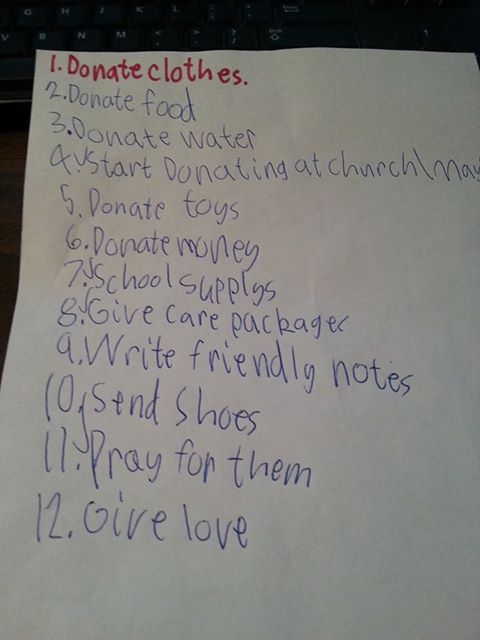
In the midst of this darkness comes the light of compassion. When nine-year-old Gavin Schroeder, a resident of Sulphur Springs in East Texas, saw the suffering in Moore (about 230 miles away) unfolding on the family TV, he wrote a list of things he'd like to do for the residents, including donating food, money and toys. Initially his father, Ken, was skeptical. After all, many charities were already underway with their own fundraising efforts. But the determined boy "didn't listen to me," Ken says, and kept pushing his parents to let him do his part.


Ken posted an image of his son's list on Facebook and within minutes began receiving messages, e-mails and texts from friends and family asking how they could help. Realizing that now was the time to act on Gavin's idea, Ken quickly set up a Facebook page for the More4Moore campaign, along with a PayPal account to raise money.

Within the first 24 hours donors had given over $750 (£500), and the Schroeder family had talked the local Lowe's (US equivalent of Homebase) into donating a pallet loaded with bottled water and hundreds of batteries. Wal-Mart also decided to pitch in and this Sunday, Ken's church will ask for a special offering.

Click here to finish reading this piece via the Huffington Post, where it was a featured blog of the day. 

Saturday, May 11, 2013

They May Take Our Lives, But They'll Never Take Our Espresso Beans


My latest ex-pat dispatch from the Land of the Free concerns an outrageous impingement of, well, freedom - at least for those people who, like myself, are confessed espresso addicts.

While perusing the website of The Atlantic (to which I subscribe) I noticed that one of the top ten posts was this little gem on potential government regulation...not of firearms, which is the most contentious topic in American politics, but of caffeine.

The writer does a fine job of explaining why the FDA is thinking of investigating and regulating caffeinated products. Now, my own tipple of choice is not one of the synthetic caffeine drinks that contain enough of the stuff to kill a horse, but rather good ol' java. My wife thinks I love my Gaggia Classic and MDF grinder a little too much, and she's probably right. But the ability to get a double-shot pick-me-up with freshly roasted beans (thanks, Kansas City's finest, the Roasterie) without leaving the house is both a path to Re-Caffeination Happy Land and a welcome excuse to get my eyes off my laptop screen. And, while my meager skills won't get me an invite to the World Barista Championships any time soon, I enjoy the process of grinding, tamping and sipping.


Yes, I am an aspiring espresso geek who is too spoiled to have any hope of surviving another Great Depression. But hey, everyone needs a hobby, right, and I like it that mine is an unregulated one. At least for now.

The first indicator I encountered that my age old right to drink espresso might be under threat (there must be a section of the Bill of Rights or US Constitution that covers this, surely) was on a trip to California last year. I ordered a couple of iced Americanos at a Starbucks in San Diego and when the green-aproned employee called my name, I went up to collect my drink and my wife's. A sign on the counter diverted my eyes away from the awaiting Caffeine Delivery Mechanism (henceforth, CDM). A promo for a new seasonal coffee? Maybe some manner of sugary temptation to get me back to the till? Nope. Instead a terrifyingly-worded warning that the beverage I was about to consume contained a compound "known to the [Nanny] State of California to cause cancer and reproductive toxicity."

A while ago, a libertarian friend warned me that the Obama administration "is coming for whatever you're into next." My day of reckoning was upon me.

Once safely back in Kansas, where such hyper-interventionist, Prop 65 silliness is thankfully not entertained, I forgot about the overbearing sign, at least once I'd e-mailed a pic of it and a mocking caption to a few friends who share my love of the Good Bean and share my suspicion of over-regulation.

But the article from Mr. Hamblin at The Atlantic has reopened my worry vault. I salute his balanced reporting, but fret over future regulation from the federal government. Will I have to obtain a license to buy a pound of espresso beans? Sign a waiver before I pay? Start some kind of speakeasy where my friends and family can enjoy a cup o' Joe on my now-illegal equipment away from the ever-watchful gaze of Big Brother at the National Central Bureau for the Synergized Prevention of Caffeinated Enjoyment and Merriment?


Click here to finish reading this article via The Huffington Post.

Want a signed copy of my book, Our Supreme Task? Then click here to e-mail me.

Agree with what I wrote? Disagree? Have a question? Then please leave a comment on my blog or on the HuffPo page.


Tuesday, April 30, 2013

The Winston Churchill Fiver, David Downing and the Berlin Blockade

I was delighted to read last week's news that from 2016, Winston Churchill will be the new face of the fiver (five pound note, about $7.50, if you're reading this in the US).

Now, my reaction isn't surprising, given that I wrote a book about Sir Winston. But it goes far beyond my appreciation for the man who led Britain through her darkest hour and into her finest.

The pound is a reminder to Brussels that Britain is still, in the best ways, the same country that Churchill gave his all to preserve. While the Tory Europhiles (step forward, Mr. Heseltine and co.) wanted to let the Euro technocrats consign our currency to the history books in favor of the gold-starred monstrosity of the Euro and Tony Blair would surely have done the same, several things stood in their way.

Chief among these was arguably Gordon Brown's finest political act: his Five Tests. These were conditions that the British economy had to meet before the then Chancellor of the Exchequer would permit Britain to join (see: capitulate to) the single currency. I'd like to believe that, despite his failings as Prime Brown is a man who understood the economic catastrophe that would be unleashed if he let Blair do away with the pound.

Because it's not just about getting to choose pictures to put on your country's notes and coins - though I believe that both American and Brits agree this is important, given the historical giants whose images these countries put on their currency (as did Jesus, and, ahem, John Maynard Keynes per this Daniel Hannan video).

In fact, the ability to make such decisions, to name your coins, to set their value, etc. is a key marker of how much influence a government and the people who elected them have over their country.

Certainly British author David Downing is aware of how important currency is not just in domestic affairs, but also on the world stage. In the wonderful conclusion to the John Russell series,Masaryk Station, Downing's protagonist ruminates on the currency reform that America, Britain and France initiate in their occupation zones within postwar Germany in 1948. Echoing Keynes, Russell tells one of his CIA handlers, "Whoever controls the currency runs the economy, and whoever controls the economy runs the country. If Washington leaves Berlin out, then they're handing it to the Russians."

And how did the Soviets respond to the currency reform? In the same manner any authoritarian regime reacts to a threat to its power and legitimacy - by attempting to reassert control in the most dramatic fashion possible. In the case of 1948, this took the shape of the Berlin Blockade, whereby Russia locked down all road, rail and water travel between its zone in the East and the British, French and American zones in the West. The goal was twofold: force the Western allies to abandon the currency change or quit Berlin. Thanks to the imagination and resolve of General Lucius Clay, George Marshall, Harry Truman, Clement Attlee and Ernest Bevin, they failed on both counts.

Click here to finish reading this article via The Huffington Post

Monday, April 22, 2013

The End of European Sovereignty: Merkel's Superstate Plan

This isn't the first time I've taken issue with Angela Merkel's attempts to squash decision making in Britain, France, her native Germany and the rest of the EU nations. But as her latest comments come at a time when the fate of the Eurozone hangs in the balance like never before, I'll risk lapsing into (gasp!) self-plagiarism.

It has long been the tendency of rulers across the political spectrum to consolidate power during times of crisis - from Caesar to Napoleon to, more recently, FDR during the aftermath of the Great Depression. Sometimes, as during war, it is necessary for leaders to do this, such as with the nationalization of British and American industry during WW2.

In the case of Merkel, Mario Draghi and the other ideological champions of the ever-expanding EU, it is the fallout of the Greek and Cypriot fiscal meltdowns that has led to their renewed calls for Brussels to wrest yet more control from countries' own democratically-elected parliaments. Speaking in Berlin, the German Chancellor said:

"We need to be ready to accept that Europe has the last word in certain areas. Otherwise we won't be able to continue to build Europe."

Merkel then turned to fear to justify her latest petition for more Europe, less sovereignty, stating that "chaos" reigned and that EU member countries are "staring over the abyss." 

Well of course you have to frighten people into believing that without your plan their lives will spiral into The Gorge of Eternal Peril if you want to impose your will on them. And it has long been the will of Merkel and her we-know-better-than-you-silly-little-European-electorates ilk to eradicate self-determination, freedom of choice and the other tenets of democracy, in favor of centralized, autocratic hegemony in the extraordinarily un-Parliamentary EU "Parliament." 

This is a body, let us remember, that ignored Ireland's "No" vote on the Lisbon Treaty EU Constitution the first time and forced another ballot, into which it poured millions of Euros to ensure a "Yes" vote.(Uh huh, I have written that before).  

A body that cared not a whit for the Irish people it compelled and duped when it imposed punitive terms upon them, and then on Greece in the wake of not-so-benevolent bailouts. 

A body that oversaw the illegal seizure of private bank account holders' funds in Cyprus. 

This is the type of institution Merkel wants to "build", as she knocks down democratic houses of Parliament and reinforces the walls of unaccountable, unchecked Fortress Brussels with the rubble. 

But it's OK because Germany is, she's quick to remind us, the "largest economy" in Europe. And bigger, of course, always knows better. And just to ensure the continuation German fiscal dominance, the EU wants to cudgel the City of London with the EU Financial Transaction Tax, which recent estimates suggest would cost Britain $6 billion a year. 

How long will the hard-working German people stand by and see Merkel pour their hard-earned wealth down the EU drain?

How long will the majority of left-leaning and mainstream media in the UK and US remain blindfolded to the folly of the Euro and the ill designs of the Brussels technocrats who control it?

How long will Britain stand idly by, thinking that holding an In/Out referendum in 2017 (newsflash, that's four years away!) is enough? 

It is high time for The Politician Formerly Known as Frau Nein to hear again, this time in Dolby 7.1 surround sound, that resounding cry Margaret Thatcher uttered over the EU's domination of Europe: "No, No, No!"

Otherwise, it will not be "certain" areas of life in its member nations that the EU takes over, but all areas, as the United States of Europe becomes a hideous reality.


Thursday, April 18, 2013

Boston Marathon 'Right Wing' Talk Does Left, Right and Center a Disservice


Does partisanship know no bounds? Is it impossible for liberals and conservatives to see ambiguity? Can we focus on healing the wounded, instead of hurling hurtful words at ideological 'opponents'?

In the wake of the Boston bombing, I'm afraid to say the answer to all three questions is "No."

As soon as the news broke of the awful events at the marathon, the blogosphere, Twitter and Facebook lit up with theories about who was to blame. Maybe it was North Korean, Syria or Iran. Perhaps an isolated, unstable person like James Holmes, the alleged Aurora shooter. But wait, it's Tax Day in the US, and Patriots' Day. The Tea Party is calling for lower taxes and less government. That's it! It must have been the work of subversive "right wing" forces! Draw line to Timothy McVeigh. Case closed.

Really? Has our determination to politicize, polarize and polemicize every aspect of American society gone this far? I know we're all into playing the blame game, of pointing fingers, of pushing responsibility onto anyone else but ourselves. But to start pointing fingers to either side of the political spectrum in the wake of such a tragedy is irresponsible and intellectually dishonest.

The next (il)logical leap for some commentators is to not only blame so-called "right wing extremists" but to finger Conservatism itself as being reactionary, hateful and destructive. If those who are right of center weren't directly responsible, they're still on the hook, according to some.New York Times writer Nicholas Kristof tweeted, "Explosion is a reminder that ATF needs a director. Shame on Senate Republicans for blocking apptment."

Now, the bomber and his or her co-conspirators may end up being tied to an extremist group. I'm not ruling that out, but my point is this knee-jerk "look left, look right, assign blame without thinking" approach has got to stop. By demonizing right or left, and/or seeking to label a political philosophy that we don't agree with as "evil" instead of wrong-headed, is profoundly destructive. As we bemoan gridlock in Washington (Nicholas Kristof was correct about that), shake our heads as we see Republicans' and Democrats' inability to pass a solid budget and our confidence level in Congress slips further, to 13%, why are we so determined to heap kindling on the partisan fire?

Click here to keep reading this article via The Huffington Post