Showing posts with label Winston Churchill. Show all posts

Wednesday, December 10, 2014

A Political Apprenticeship: What Winston Churchill Taught Harry Truman

The two men couldn't have been more different. One was born in a magnificent palace, the other in a humble farmhouse. One had been in politics for 40 years, the other was a relative newcomer. One was lauded as his country's greatest Prime Minister. The other was derided as an accidental President.
And yet, as the Allies won World War Two and tried to make the peace, Winston Spencer Churchill and Harry [invented middle initial] S. Truman came together to check the advance of expansionist communism.
When the two first met in the grounds of the Cecilienhof Palace in Germany in July 1945, the overtones of the Potsdam Conference could not be more clear, or more menacing. A giant red star was daubed on the main lawn, and having sacrificed up to 20 million Soviet lives to repel the Wermacht on the Eastern Front, the ruthless Joseph Stalin was expecting a large slice of European pie as a reward.
2014-12-08-PotsdamStar.jpg
Since well before he ran one of the most dogged and, ultimately, successful PR campaigns of his career to court Franklin Roosevelt's support in 1940 and 1941, Churchill had realized that for democracy to survive the Nazi assault America would have to be the senior partner, and his beloved Britain the junior. With FDR now gone, it would be up to Truman to prevent Stalin from consuming all of Eastern and Central Europe, and perhaps more.
The two men liked each other from the get go, though their initial impressions are amusingly different. Truman thought that they'd get on fine as long as Churchill didn't give him too much "soft soap" - i.e the lofty words and flattery that had wooed FDR. The British bulldog, who had taken the measure of every world leader since the early 1900s, believed Truman to be a man of immense determination. "He takes no notice of solid ground whatsoever," Churchill told his physician. "He just plants his foot down on it." The Prime Minister lifted his bulk a couple of inches into the air and crashed down on his private bathroom floor to illustrate his point.
If Churchill recognized before flying to Potsdam that he would need every ounce of Truman's influence as the head of the West's new superpower, it soon became clear just how much would depend on the Man from Missouri. Halfway through the conference, Churchill flew home to receive news of what he hoped would be victory in the General Election. Instead, his Conservative Party suffered the second worst defeat in its history, meaning Churchill would play no further part in the deliberations. In his stead went the new PM Clement Attlee, a man Churchill had once allegedly referred to as "a sheep in sheep's clothing." What good would a meek lamb be against the Soviet bear?
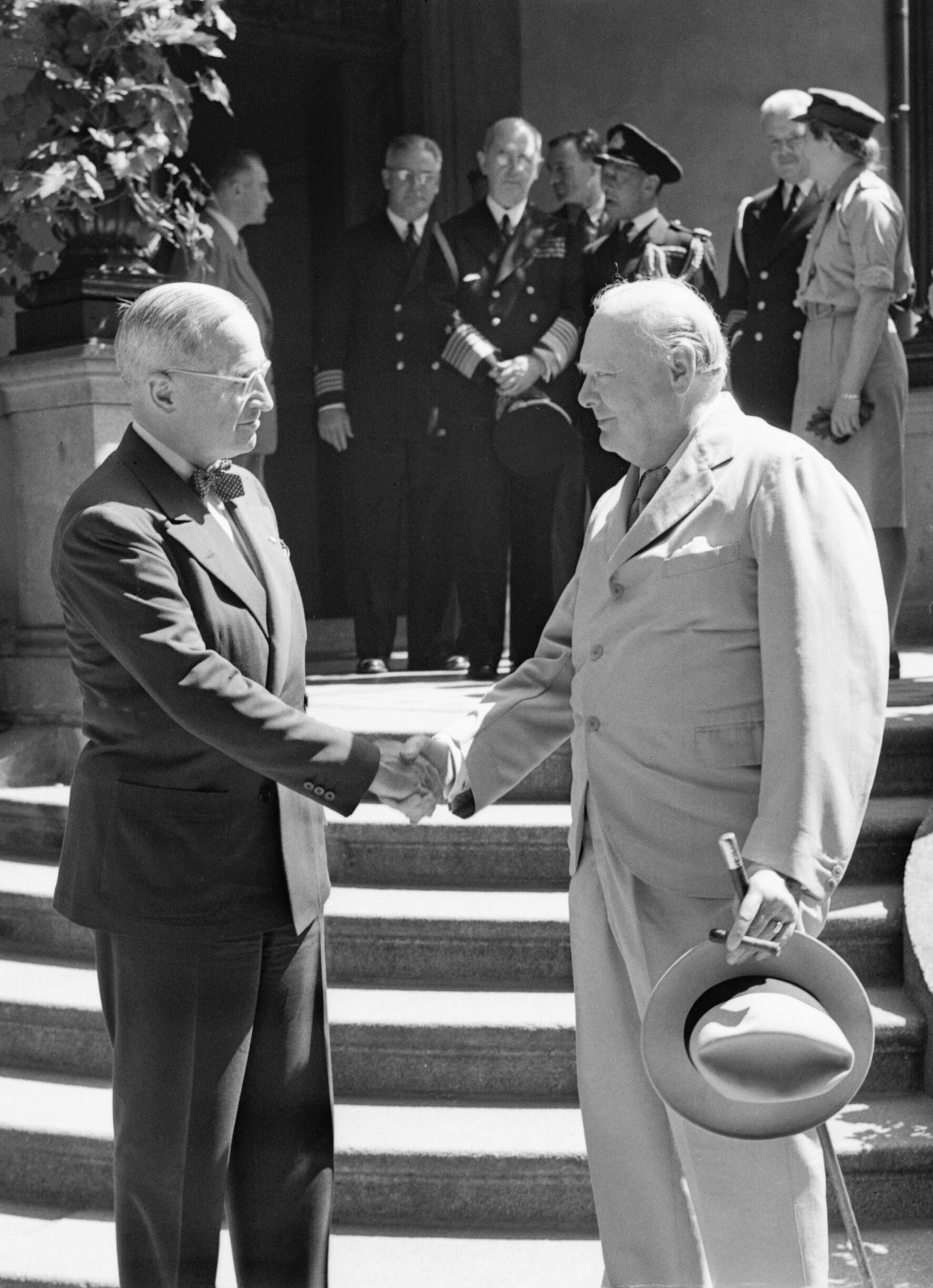
2014-12-08-ChurchillTrumanPotsdam.jpg
The answer was simple: not much. And neither did Truman win many concessions that favored the Western democracies around the Potsdam negotiating table. Stalin and his cronies got what they came for, except for Greece, which Churchill said he had "pulled from the fire on Christmas Day" during the war, but which would still be menaced by Communist revolutionaries for several years.
The Truman-Churchill story resumed in March 1946 in an unlikely venue: Truman's Presidential train car, the Ferdinand Magellan. As the locomotive sped from Washington to St. Louis, Truman's aides schooled Churchill at the poker table. But card games aside, it was Churchill who was the real teacher. The record of Churchill and Truman's conversation is unavailable, but as the American President is noted for his endless quest for knowledge (he supposedly read every book in his hometown library as a boy) and his British guest for his verbosity, it's likely that the political veteran gave more than a few pointers to his less experienced host.
Churchill was on his way to Truman's home state because the President had added a persuasive postscript to a speaking invitation from Franc Bullet McCluer, who presided over Westminster College in Fulton. Truman offered to introduce Churchill if he accepted, and the Leader of the Opposition recognized that he now had the perfect venue to air his grave concerns over the next great threat to world peace: Communism.
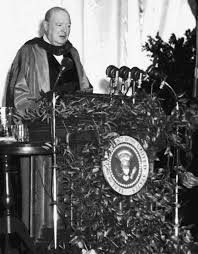
Contrary to his later denials issued when Churchill's "Sinews of Peace" speech whipped up a storm of criticism on both sides of the Atlantic, Truman certainly read and was influenced by what is now better known as "The Iron Curtain Speech." In it, Churchill spoke grimly of the iron curtain that had hewn Europe in two. On one side, Britain, France and a handful of countries were struggling to recover from the war, but their citizens enjoyed the freedoms of liberal democracy in their "cottage homes." Not so on the other side of the Iron Curtain, where the peoples of Central and Eastern Europe were subjected to Soviet tyranny. "This is certainly not the Liberated Europe we fought to build up. Nor is it one which contains the essentials of permanent peace," Churchill asserted in the Westminster College gym, as Truman looked on.

Click here to finish reading this story via The Huffington Post.

And don't forget to order my new book, Whistle Stop: How 31,000 Miles of Train Travel, 352 Speeches, and a Little Midwest Gumption Saved the Presidency of Harry Truman

Thursday, March 6, 2014

Winston Churchill, Putin's Russia and Ukraine: Timeless Lessons from the 'Iron Curtain Speech' 68 Years On

Can a speech made by a former Prime Minister 68 years ago still be relevant today? When we're talking about Winston Churchill's Sinews of Peace address (aka 'the Iron Curtain speech'), the answer is a resounding "yes."
68 years ago today, Churchill stood in  the crowded Westminster College gymnasium in Fulton, Missouri and shared his concerns about Communism, becoming the first to call out Russia for its takeover of Eastern European nations, which he claimed were becoming little more than puppet police states taking their direction from Moscow.
Churchill was widely condemned for the Fulton address. Labor MPs petitioned Prime Minister Clement Attlee to censure Churchill in the Commons, which he didn't do. Churchill heard the same insults he had endured during his "wilderness" in the 1930s, when his warnings about Hitler earned him labels like "imperialist" and "old Tory." Stalin himself dismissed his former wartime summit partner as a "warmonger." Most people in Britain and the US at the time still saw the Soviet Union as a wartime ally, and many believed that Communism - which they little understood thanks to Russian propaganda - was a viable alternative to democracy. Above all, they would do anything to avoid yet another global conflict. So their derision is understandable, and yet misplaced.
Everything Churchill claimed about the ills of Communism was true, and then some. Beyond the eradication of democracy in Eastern Europe, the Red Army had broken its promises to leave Iran, jeopardizing British and American oil supply and trade (sound familiar?). Stalin demanded military bases in Turkey, and this nation, Greece and China were on the brink of succumbing to Communist takeover. In Korea, the Soviets regularly cut off energy supplies to democratic regions to show who was really in control. Churchill and other leaders were rightly concerned that Communism would fill the void left by Hitler's demise in Germany, and Communist Party membership in Italy and France was rising dramatically. The threat to liberty and freedom was very real, and only Churchill could enunciate it, despite his loss of 10 Downing Street in the calamitous 1946 General Election.
2014-03-05-ChurchillatFulton.jpg
In addition to warning about Russian malfeasance at home and abroad, Churchill suggested how the Western democracies should respond, and what they should avoid. Simply put: strength good, weakness bad. In Churchill's words, "From what I have seen of our Russian friends and Allies during the war, I am convinced that there is nothing they admire so much as strength, and there is nothing for which they have less respect than for weakness, especially military weakness." This was not, as Churchill's critics asserted, a battle cry, but was rather just stating a fact: show weakness and Russia will take advantage. Show strength, and you will earn respect.
Fast forward 68 years and much has changed in Russia since Churchill's wakeup call in Missouri. And yet much remains the same. The so-called "elections" that keep Putin in power (the most recent falling, ironically, on the same date as Churchill's Fulton address) are little more than stagecraftexpertly managed by the ex KGB man's cronies to give the world the false impression that real democracy is reality in Russia. Politicians who oppose the Kremlin are imprisoned or thrown out of (one-horse) political 'races.' Journalists who dare to tell the truth are silenced. Even citizens on foreign soil are not safe if they air a dissenting voice - as Alexander Litvinenko found out to his cost . There is certainly choice in modern Russia - if you choose Putin and his brand of hyper-masculine nationalism, you thrive. If not, you wilt.
So the Cold War may be over, Communism may have receded and Putin may be less of a tyrant than his post-World War II predecessors. But Churchill's words still ring true.

Tuesday, January 28, 2014

Tell It Like It Is, Dave: Cameron Calls Out the EU on Bureaucracy

For most of 2013, David Cameron seemingly couldn't please anyone. The "we want out of Europe" wing of the Conservative Party didn't think he'd done enough, even with the 2017 In/Out referendum pledge, to further their cause. The British economy sputtered like an old engine on a frigid morning. And the Tories slipped up in by-elections that many political commentators viewed as an indictment of Cameron's leadership.
Barely a month into 2014, and Cameron must feel like the storm clouds have finally cleared. Unemployment dropped to 7.1 percent and the number of people out of work fell by 167,000 since November - signs that the UK economy is creating jobs and at last pulling out of its recent slump. Such figures undermine Ed Miliband's vague, unsubstantiated claim that "life's getting harder" for the average Briton.
Certainly, last week's news that the House of Lords has sent the EU Referendum Bill back to the Commons for re-wording is less than ideal. But Cameron has proved his commitment to getting Britain a "better deal" in Europe by pushing the matter and, in practical terms, can do little more to satisfy Euroskeptics at this point.
Well, except maybe continuing to deliver speeches like last week's salvo at the World Economic Forum in Davos. There, Cameron offered re-assurance to his Get-Us-Out supporters that the "fight is not yet won." He then took the EU to task for it's cloying, go-slow bureaucracy, claiming that if Brussels workers aren't producing regulations for regulations' sake they feel like "they're not doing their job."

david cameron
After revealing his hopes that fracking would lower energy bills and encourage employers to move jobs back to the UK ("reshoring") to take advantage of cheap energy, the Prime Minister then shared his fear that such potential benefits would be strangled by "burdensome, unjustified and premature regulatory burdens" from Brussels. Such over-regulation permeates every edict the EU issues, Cameron stated, as what Daniel Hannan has called "euro-apparatchiks" view any attempt to simplify policy as "an act of self-harm."
Regardless of what people think of fracking, it's hard to argue against the key premise of Dave's diatribe: that the EU is a bloated entity that exists merely to further its own over-reaching power. 

Click here to finish reading this blog entry via The Huffington Post

Tuesday, April 30, 2013

The Winston Churchill Fiver, David Downing and the Berlin Blockade

I was delighted to read last week's news that from 2016, Winston Churchill will be the new face of the fiver (five pound note, about $7.50, if you're reading this in the US).

Now, my reaction isn't surprising, given that I wrote a book about Sir Winston. But it goes far beyond my appreciation for the man who led Britain through her darkest hour and into her finest.

The pound is a reminder to Brussels that Britain is still, in the best ways, the same country that Churchill gave his all to preserve. While the Tory Europhiles (step forward, Mr. Heseltine and co.) wanted to let the Euro technocrats consign our currency to the history books in favor of the gold-starred monstrosity of the Euro and Tony Blair would surely have done the same, several things stood in their way.

Chief among these was arguably Gordon Brown's finest political act: his Five Tests. These were conditions that the British economy had to meet before the then Chancellor of the Exchequer would permit Britain to join (see: capitulate to) the single currency. I'd like to believe that, despite his failings as Prime Brown is a man who understood the economic catastrophe that would be unleashed if he let Blair do away with the pound.

Because it's not just about getting to choose pictures to put on your country's notes and coins - though I believe that both American and Brits agree this is important, given the historical giants whose images these countries put on their currency (as did Jesus, and, ahem, John Maynard Keynes per this Daniel Hannan video).

In fact, the ability to make such decisions, to name your coins, to set their value, etc. is a key marker of how much influence a government and the people who elected them have over their country.

Certainly British author David Downing is aware of how important currency is not just in domestic affairs, but also on the world stage. In the wonderful conclusion to the John Russell series,Masaryk Station, Downing's protagonist ruminates on the currency reform that America, Britain and France initiate in their occupation zones within postwar Germany in 1948. Echoing Keynes, Russell tells one of his CIA handlers, "Whoever controls the currency runs the economy, and whoever controls the economy runs the country. If Washington leaves Berlin out, then they're handing it to the Russians."

And how did the Soviets respond to the currency reform? In the same manner any authoritarian regime reacts to a threat to its power and legitimacy - by attempting to reassert control in the most dramatic fashion possible. In the case of 1948, this took the shape of the Berlin Blockade, whereby Russia locked down all road, rail and water travel between its zone in the East and the British, French and American zones in the West. The goal was twofold: force the Western allies to abandon the currency change or quit Berlin. Thanks to the imagination and resolve of General Lucius Clay, George Marshall, Harry Truman, Clement Attlee and Ernest Bevin, they failed on both counts.

Click here to finish reading this article via The Huffington Post

Saturday, April 6, 2013

Peace Through Strength and David Cameron: Not a Love Story


This week I had the pleasure of reading a well-craftedWall Street Journal blog post by Pete Du Pont, in which he argues that President Barack Obama would do well to put Ronald Reagan's "peace through strength" mantra into practice.

But what of David Cameron and the British military? Surely a Conservative Prime Minister has preserved Britain as a global force to be reckoned with, even after the follies of his predecessor in Afghanistan and Iraq? Particularly a Conservative Prime Minister who just vocally advocated for the continuation of his nation's Trident nuclear deterrent?

Not so much. Despite the Trident statement and William Hague's belief that a strong, capable Army, Navy and Royal Air Force is necessary to protect us from traditional threats and combat the malevolence of terrorists, the Conservative Party seems to have either disregarded Reagan's theory or confused it for "strength through weakness." First there was the 8% cut in 2010, then the decommissioning of the HMS Ark Royal aircraft carrier, and the removal of the Desert Rats' tanks. By the time Cameron and co are up for reelection, they'll have pensioned off thousands of troops.

And the Prime Minister may not stop there if he returns to Number 10 Downing Street, recentlyrefusing to eliminate the possibility of further weakening British forces if he wins reelection in 2015.

Reagan's "peace through strength" stance (best expressed in this 1986 speech) is not some obscure American concept, but rather has its roots in Winston Churchill's 'Iron Curtain' address in 1946. In it, Churchill stated that Stalin and his cronies would only push Communism westward if they thought Britain and America were too weak to prevent it. "I am convinced," Churchill said, "that there is nothing they admire so much as strength, and there is nothing for which they have less respect than for weakness, especially military weakness." 

Remember that the actual title of this talk was not the 'Iron Curtain' speech, but actually "The Sinews of Peace." Contrary to the claims of revisionist detractors, it was peace, not war, that Churchill wanted. And he knew that to withstand Communism, Britain must stand strong and stand with its "special relationship" partners - the United States, Canada, Australia et al - in good times and in ill.

Of course, the world of combat is not the same as it was under Churchill, Thatcher or even Blair. Military forces must be increasingly fast and mobile, drones are fast replacing manned fighter planes and the need for a large-scale ground invasion as in the Gulf War is, thankfully, receding.

Yet saber-rattling Iranian President Mahmoud Ahmadinejad, strongman Russian President Vladimir Putin and even posturing North Korean President Kim Jong-Un will be merely encouraged to test our resolve by the sight of Britain's military spending and personnel cuts.

Click here to finish reading this article at Huffington Post UK

To read my other Huffington Post entries, click here

Saturday, March 9, 2013

Winston Churchill's Iron Curtain Speech: Still Relevant, 67 Years On


This week marks the 67th anniversary of Winston Churchill's 'Iron Curtain' address (actually named 'The Sinews of Peace'), which he called "the most important speech of my career". And he'd given one or two of those.
Churchill's speech in the unlikely venue of Westminster College in Fulton, Missouri, was panned at the time for blasting Soviet Russia, whom many in Britain and the US still considered an ally, for warning of the potential of World War Three and for calling out the divisions between the Communist East and democratic West. Of course, Churchill's illustration of the "iron curtain" (a term he made popular but did not invent) was later embodied in the defining symbol of the Cold War - the Berlin Wall. And you can hardly watch a news broadcast on foreign affairs without hearing Churchill's term for the bond between the US and the British Commonwealth, the "special relationship" (though quite how "special" it is right now is debatable.)


But is the speech still worth listening to and reading about, all these years later? After all, we'll be celebrating the 25th anniversary of the Berlin Wall next year and though Communism remains a force, it is hardly the global menace that Churchill spoke of. Despite these facts, I believe Churchill's "most important" speech should indeed be studied, and not merely as a historical relic. Here are a few reasons why:
1) Leadership 

When he spoke in Fulton in March 1946, Churchill was no longer Prime Minister. The Conservative Party was punished for things that happened before Winston became head of a coalition government - not least the appeasement of Baldwin and Chamberlain and the poor standard of living many Britons had during their tenure. While the Tories campaigned on the strength of Churchill's war leadership, the Labour Party looked forward, creating a manifesto that addressed the postwar housing shortage, rebuilding wartime damage and, for good or for ill, extending socialized medicine.
But though he had lost his post of prime minister, Churchill's role of statesman was not over. He recognized that his stark warning about Communism would be unpopular, as did Harry Truman, who later disingenuously denied reading the speech before Churchill delivered it.
Yet Churchill recognized that to truly lead you must be willing to risk unpopularity, even ridicule, to tell hard truths. And what he said at Fulton - about the perils of expansionist Communism, about the need for the US, Britain and the rest of the English-speaking peoples to stand together in good times and in ill - was certainly truth. As predicted, Churchill was derided as an imperialist, an old Tory, and, by Stalin himself, as a warmonger. And yet, after braving hundreds of protesters yelling "GI Joe is home to stay, Winnie, Winnie, go away" to give another bold speech days later at New York's Waldorf Astoria hotel, Churchill stood his ground, stating that "I do not wish to withdraw or modify a single word."


Click here to read the rest of this article via the Huffington Post.

Monday, March 4, 2013

This Week Only: Get Signed Copy Of Our Supreme Task (story of Churchill's Iron Curtain Speech) for $10 + Postage

To celebrate the paperback release of Our Supreme Task - the story behind Winston Churchill's Iron Curtain speech and visit to Fulton, MO - I'n offering signed copies for just $10 + postage this week to anyone in the US.

If you'd like a signed hardback, just leave a comment on this blog post with your e-mail address and I will contact you to setup payment and delivery. If you have a problem with the comments (curse you, internet!), just e-mail me at alionintheheartland@gmail.com.

Copies are limited so don't delay.