Showing posts with label Vladimir Putin. Show all posts

Thursday, March 6, 2014

Winston Churchill, Putin's Russia and Ukraine: Timeless Lessons from the 'Iron Curtain Speech' 68 Years On

Can a speech made by a former Prime Minister 68 years ago still be relevant today? When we're talking about Winston Churchill's Sinews of Peace address (aka 'the Iron Curtain speech'), the answer is a resounding "yes."
68 years ago today, Churchill stood in  the crowded Westminster College gymnasium in Fulton, Missouri and shared his concerns about Communism, becoming the first to call out Russia for its takeover of Eastern European nations, which he claimed were becoming little more than puppet police states taking their direction from Moscow.
Churchill was widely condemned for the Fulton address. Labor MPs petitioned Prime Minister Clement Attlee to censure Churchill in the Commons, which he didn't do. Churchill heard the same insults he had endured during his "wilderness" in the 1930s, when his warnings about Hitler earned him labels like "imperialist" and "old Tory." Stalin himself dismissed his former wartime summit partner as a "warmonger." Most people in Britain and the US at the time still saw the Soviet Union as a wartime ally, and many believed that Communism - which they little understood thanks to Russian propaganda - was a viable alternative to democracy. Above all, they would do anything to avoid yet another global conflict. So their derision is understandable, and yet misplaced.
Everything Churchill claimed about the ills of Communism was true, and then some. Beyond the eradication of democracy in Eastern Europe, the Red Army had broken its promises to leave Iran, jeopardizing British and American oil supply and trade (sound familiar?). Stalin demanded military bases in Turkey, and this nation, Greece and China were on the brink of succumbing to Communist takeover. In Korea, the Soviets regularly cut off energy supplies to democratic regions to show who was really in control. Churchill and other leaders were rightly concerned that Communism would fill the void left by Hitler's demise in Germany, and Communist Party membership in Italy and France was rising dramatically. The threat to liberty and freedom was very real, and only Churchill could enunciate it, despite his loss of 10 Downing Street in the calamitous 1946 General Election.
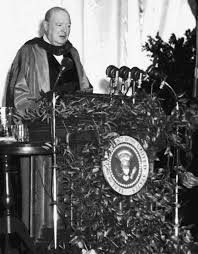
2014-03-05-ChurchillatFulton.jpg
In addition to warning about Russian malfeasance at home and abroad, Churchill suggested how the Western democracies should respond, and what they should avoid. Simply put: strength good, weakness bad. In Churchill's words, "From what I have seen of our Russian friends and Allies during the war, I am convinced that there is nothing they admire so much as strength, and there is nothing for which they have less respect than for weakness, especially military weakness." This was not, as Churchill's critics asserted, a battle cry, but was rather just stating a fact: show weakness and Russia will take advantage. Show strength, and you will earn respect.
Fast forward 68 years and much has changed in Russia since Churchill's wakeup call in Missouri. And yet much remains the same. The so-called "elections" that keep Putin in power (the most recent falling, ironically, on the same date as Churchill's Fulton address) are little more than stagecraftexpertly managed by the ex KGB man's cronies to give the world the false impression that real democracy is reality in Russia. Politicians who oppose the Kremlin are imprisoned or thrown out of (one-horse) political 'races.' Journalists who dare to tell the truth are silenced. Even citizens on foreign soil are not safe if they air a dissenting voice - as Alexander Litvinenko found out to his cost . There is certainly choice in modern Russia - if you choose Putin and his brand of hyper-masculine nationalism, you thrive. If not, you wilt.
So the Cold War may be over, Communism may have receded and Putin may be less of a tyrant than his post-World War II predecessors. But Churchill's words still ring true.

Tuesday, July 17, 2012

Book Review: 'The Blind Spy' by Alex Dryden

The Blind Spy, the third volume of Alex Dryden's series of novels on Putin's Russia, has been out in the UK for some time, but has just been released as a U.S. hardcover by Ecco. For me, the 18-month delay was worth the wait.

Dryden's opening book, Red to Black, focused on the British spy Finn and his forbidden love, the KGB colonel Anna Resnikov. Proving that great fiction writers don't care so much for their characters that they prevent them from harm, Dryden dramatically offed Finn in the final pages, as his protagonist dug deeper and deeper into the shadowy world of illicit Russian billions and the illegal activities that both fueled and profited from them.

Book two, Moscow Sting, saw Resnikov defecting to the United States with her son, Finn, after their cover in France was blown by a bitter and confused ex-CIA agent, Logan Halloran. He had offered her location to the Russians, British and Americans, and it was the American private security firm Cougar -- created with more than a nod to Blackwater and its ilk -- that paid top dollar. Though she had little choice in the matter, Resnikov is happy to work with Cougar and its dominant, brilliant and larger-than-life supremo, Burt Miller, who may just be more powerful than the CIA Director he frequently works with, for her own ends. Though she is driven by revenge for Finn's death, she has realized that Putin's Moscow is rotten to the core, and will stop at nothing to bring about change in her homeland.

In The Blind Spy, Resnikov's involvement with Cougar is intensified. She has successfully brought an influential countryman and former member of Putin's inner circle, a man known only as his cover name, Mikhail, over to the intelligence firm. And rather than sit back as a consultant, she has reluctantly given up her son, who is being raised by ex-operatives on a farm in Connecticut, so she can focus full-time on bringing down Putin's administration. At her insistence, she is acting as a field operative in Ukraine, attempting to discover how Russia's attempts to stamp out nascent democracy in the former Soviet state and bring it back under Moscow's control.

To complicate matters, Miller is allowing Halloran to work in the same area. In addition to being aware of his betrayal, Resnikov was the unwilling subject of his affections during her first few months in the U.S., and is now trying to focus on her work in spite of his continued ardor and loose-cannon personality. She also has to contend with a leak in either Cougar or the CIA that compromises her safety in the Crimea, and the ire of the KGB, which will stop at nothing to capture her and make her pay for her defection. Their point man for this is Balthasar, a formidable operative whose blindness is more than compensated for by intuition and an uncanny knack for sensing the motivations of those around him.

When reading such a book, I have to be convinced that the author is credible, and when it comes to Putin-era Russia, there is no question that Dryden knows his stuff. From detailed descriptions of time and place to a masterful understanding of what makes today's Russia tick, he creates a realistic and, at times, terrifying portrayal. Dryden's development of his heroine is also first-rate. While he mentions her physical beauty and the impact of it on male colleagues too often, Dryden has expertly drawn a complex, conflicted and intriguing character who is living trapped between the Russia of her past, the America of her present and the unknown destination of her future. At first I struggled to reconcile her decision to give up the son who was the living reminder of her great love, Finn, and yet as Dryden's narrative progressed, it became clear that his was necessary for his safety and to her success in the field. Dryden could have fallen into the trap of sentimentality here or its opposite, callousness, but he avoids both, showing a mother who loves her son with all her being, but also exists to secure a better world for him to grow up in.

Click here to read the rest of this review on The Huffington Post website

Sunday, March 4, 2012

Vladimir Putin, Winston Churchill and the Trampling of Democracy

Tomorrow, March 5, marks the 66th anniversary of Winston Churchill's The Sinews of Peace address, better known as the "Iron Curtain" speech. A lot has changed since Churchill took the podium at Westminster College in Fulton, Missouri, in 1946. And yet, while the Soviet Union, the gulags and the KGB are no more, Russia is in many ways no closer to true democracy.

One of the primary reasons for this is the reign of Vladimir Putin, himself an former member of the KGB. Today, Putin won another six years at the helm of his nation in an election that was supposedly democratic. "We won in an open and honest struggle!" he told a rapturous crowd that cheered his victory as they gathered outside the Kremlin on a frigid Moscow night.

Despite Putin's typically bold claims, there have been dozens of reports of voting irregularities and electoral frauds that would be almost laughable if their consequences weren't so serious, including "carousel voting," whereby buses of voters are driven to many different polling stations to punch many ballots. Independent monitors have broadcast these abuses to the world media, but Putin and his cronies simply don't care - they just issue one dismissive denial after another.

In the "Iron Curtain" speech, Churchill stated, "the people of any country have the right, and should have the power by constitutional action, by free unfettered elections, with secret ballot, to choose or change the character or form of government under which they dwell." If the election monitors are to be believed, nothing of the sort took place in Russia. And nor will it at any point during the next stage of Putin's reign, which began in 2000. Maybe in time for the 75th anniversary of Churchill's call for universal democracy and liberty, the Russian people can shake off Putin's yoke and finally take hold of the "title deeds of freedom."