Showing posts with label Iron Curtain Speech. Show all posts

Wednesday, December 10, 2014

A Political Apprenticeship: What Winston Churchill Taught Harry Truman

The two men couldn't have been more different. One was born in a magnificent palace, the other in a humble farmhouse. One had been in politics for 40 years, the other was a relative newcomer. One was lauded as his country's greatest Prime Minister. The other was derided as an accidental President.
And yet, as the Allies won World War Two and tried to make the peace, Winston Spencer Churchill and Harry [invented middle initial] S. Truman came together to check the advance of expansionist communism.
When the two first met in the grounds of the Cecilienhof Palace in Germany in July 1945, the overtones of the Potsdam Conference could not be more clear, or more menacing. A giant red star was daubed on the main lawn, and having sacrificed up to 20 million Soviet lives to repel the Wermacht on the Eastern Front, the ruthless Joseph Stalin was expecting a large slice of European pie as a reward.
2014-12-08-PotsdamStar.jpg
Since well before he ran one of the most dogged and, ultimately, successful PR campaigns of his career to court Franklin Roosevelt's support in 1940 and 1941, Churchill had realized that for democracy to survive the Nazi assault America would have to be the senior partner, and his beloved Britain the junior. With FDR now gone, it would be up to Truman to prevent Stalin from consuming all of Eastern and Central Europe, and perhaps more.
The two men liked each other from the get go, though their initial impressions are amusingly different. Truman thought that they'd get on fine as long as Churchill didn't give him too much "soft soap" - i.e the lofty words and flattery that had wooed FDR. The British bulldog, who had taken the measure of every world leader since the early 1900s, believed Truman to be a man of immense determination. "He takes no notice of solid ground whatsoever," Churchill told his physician. "He just plants his foot down on it." The Prime Minister lifted his bulk a couple of inches into the air and crashed down on his private bathroom floor to illustrate his point.
If Churchill recognized before flying to Potsdam that he would need every ounce of Truman's influence as the head of the West's new superpower, it soon became clear just how much would depend on the Man from Missouri. Halfway through the conference, Churchill flew home to receive news of what he hoped would be victory in the General Election. Instead, his Conservative Party suffered the second worst defeat in its history, meaning Churchill would play no further part in the deliberations. In his stead went the new PM Clement Attlee, a man Churchill had once allegedly referred to as "a sheep in sheep's clothing." What good would a meek lamb be against the Soviet bear?
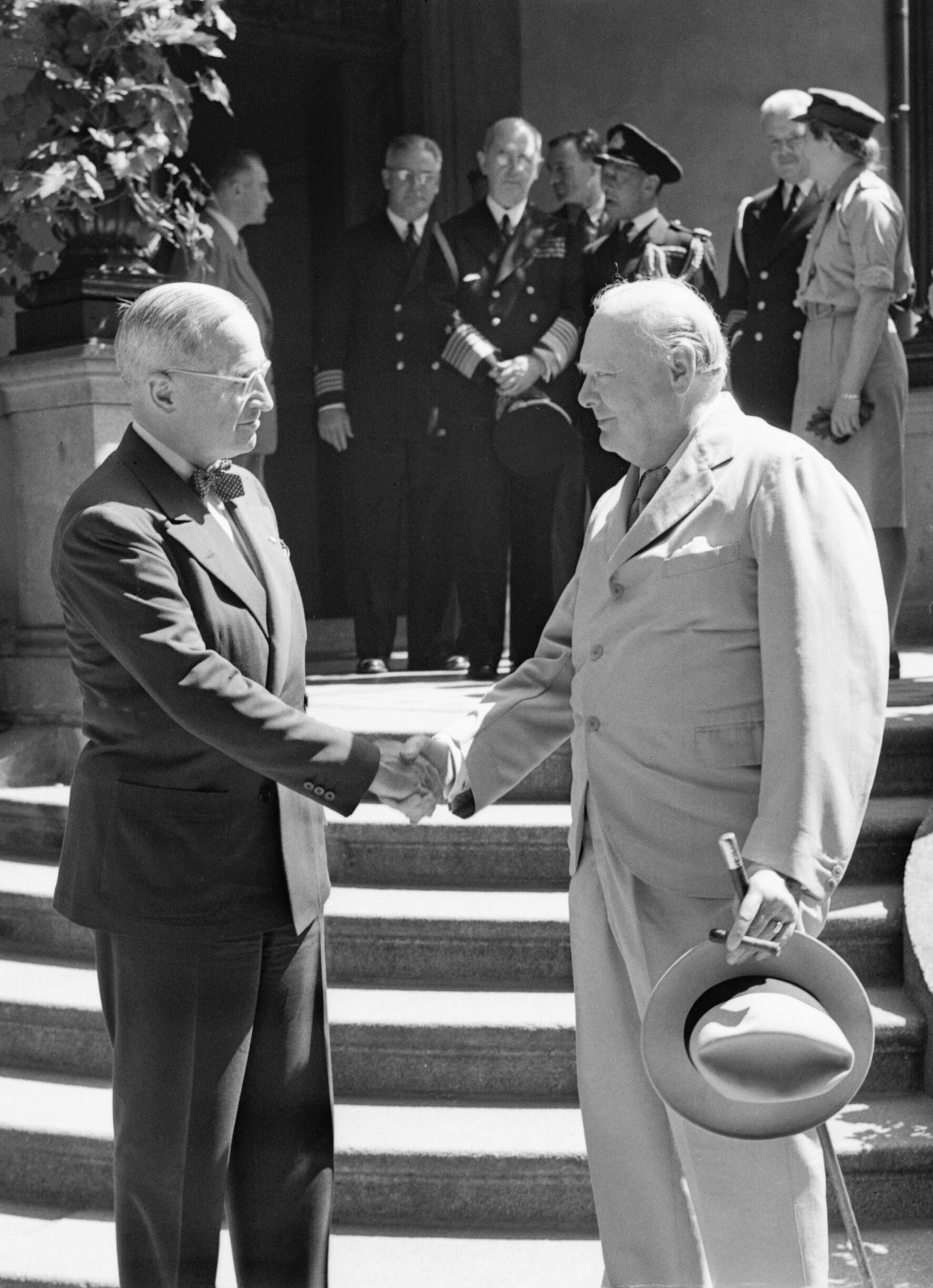
2014-12-08-ChurchillTrumanPotsdam.jpg
The answer was simple: not much. And neither did Truman win many concessions that favored the Western democracies around the Potsdam negotiating table. Stalin and his cronies got what they came for, except for Greece, which Churchill said he had "pulled from the fire on Christmas Day" during the war, but which would still be menaced by Communist revolutionaries for several years.
The Truman-Churchill story resumed in March 1946 in an unlikely venue: Truman's Presidential train car, the Ferdinand Magellan. As the locomotive sped from Washington to St. Louis, Truman's aides schooled Churchill at the poker table. But card games aside, it was Churchill who was the real teacher. The record of Churchill and Truman's conversation is unavailable, but as the American President is noted for his endless quest for knowledge (he supposedly read every book in his hometown library as a boy) and his British guest for his verbosity, it's likely that the political veteran gave more than a few pointers to his less experienced host.
Churchill was on his way to Truman's home state because the President had added a persuasive postscript to a speaking invitation from Franc Bullet McCluer, who presided over Westminster College in Fulton. Truman offered to introduce Churchill if he accepted, and the Leader of the Opposition recognized that he now had the perfect venue to air his grave concerns over the next great threat to world peace: Communism.
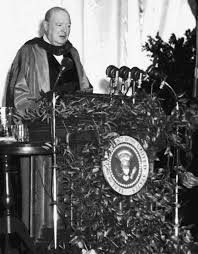
Contrary to his later denials issued when Churchill's "Sinews of Peace" speech whipped up a storm of criticism on both sides of the Atlantic, Truman certainly read and was influenced by what is now better known as "The Iron Curtain Speech." In it, Churchill spoke grimly of the iron curtain that had hewn Europe in two. On one side, Britain, France and a handful of countries were struggling to recover from the war, but their citizens enjoyed the freedoms of liberal democracy in their "cottage homes." Not so on the other side of the Iron Curtain, where the peoples of Central and Eastern Europe were subjected to Soviet tyranny. "This is certainly not the Liberated Europe we fought to build up. Nor is it one which contains the essentials of permanent peace," Churchill asserted in the Westminster College gym, as Truman looked on.

Click here to finish reading this story via The Huffington Post.

And don't forget to order my new book, Whistle Stop: How 31,000 Miles of Train Travel, 352 Speeches, and a Little Midwest Gumption Saved the Presidency of Harry Truman

Thursday, March 6, 2014

Winston Churchill, Putin's Russia and Ukraine: Timeless Lessons from the 'Iron Curtain Speech' 68 Years On

Can a speech made by a former Prime Minister 68 years ago still be relevant today? When we're talking about Winston Churchill's Sinews of Peace address (aka 'the Iron Curtain speech'), the answer is a resounding "yes."
68 years ago today, Churchill stood in  the crowded Westminster College gymnasium in Fulton, Missouri and shared his concerns about Communism, becoming the first to call out Russia for its takeover of Eastern European nations, which he claimed were becoming little more than puppet police states taking their direction from Moscow.
Churchill was widely condemned for the Fulton address. Labor MPs petitioned Prime Minister Clement Attlee to censure Churchill in the Commons, which he didn't do. Churchill heard the same insults he had endured during his "wilderness" in the 1930s, when his warnings about Hitler earned him labels like "imperialist" and "old Tory." Stalin himself dismissed his former wartime summit partner as a "warmonger." Most people in Britain and the US at the time still saw the Soviet Union as a wartime ally, and many believed that Communism - which they little understood thanks to Russian propaganda - was a viable alternative to democracy. Above all, they would do anything to avoid yet another global conflict. So their derision is understandable, and yet misplaced.
Everything Churchill claimed about the ills of Communism was true, and then some. Beyond the eradication of democracy in Eastern Europe, the Red Army had broken its promises to leave Iran, jeopardizing British and American oil supply and trade (sound familiar?). Stalin demanded military bases in Turkey, and this nation, Greece and China were on the brink of succumbing to Communist takeover. In Korea, the Soviets regularly cut off energy supplies to democratic regions to show who was really in control. Churchill and other leaders were rightly concerned that Communism would fill the void left by Hitler's demise in Germany, and Communist Party membership in Italy and France was rising dramatically. The threat to liberty and freedom was very real, and only Churchill could enunciate it, despite his loss of 10 Downing Street in the calamitous 1946 General Election.
2014-03-05-ChurchillatFulton.jpg
In addition to warning about Russian malfeasance at home and abroad, Churchill suggested how the Western democracies should respond, and what they should avoid. Simply put: strength good, weakness bad. In Churchill's words, "From what I have seen of our Russian friends and Allies during the war, I am convinced that there is nothing they admire so much as strength, and there is nothing for which they have less respect than for weakness, especially military weakness." This was not, as Churchill's critics asserted, a battle cry, but was rather just stating a fact: show weakness and Russia will take advantage. Show strength, and you will earn respect.
Fast forward 68 years and much has changed in Russia since Churchill's wakeup call in Missouri. And yet much remains the same. The so-called "elections" that keep Putin in power (the most recent falling, ironically, on the same date as Churchill's Fulton address) are little more than stagecraftexpertly managed by the ex KGB man's cronies to give the world the false impression that real democracy is reality in Russia. Politicians who oppose the Kremlin are imprisoned or thrown out of (one-horse) political 'races.' Journalists who dare to tell the truth are silenced. Even citizens on foreign soil are not safe if they air a dissenting voice - as Alexander Litvinenko found out to his cost . There is certainly choice in modern Russia - if you choose Putin and his brand of hyper-masculine nationalism, you thrive. If not, you wilt.
So the Cold War may be over, Communism may have receded and Putin may be less of a tyrant than his post-World War II predecessors. But Churchill's words still ring true.

Saturday, March 9, 2013

Winston Churchill's Iron Curtain Speech: Still Relevant, 67 Years On


This week marks the 67th anniversary of Winston Churchill's 'Iron Curtain' address (actually named 'The Sinews of Peace'), which he called "the most important speech of my career". And he'd given one or two of those.
Churchill's speech in the unlikely venue of Westminster College in Fulton, Missouri, was panned at the time for blasting Soviet Russia, whom many in Britain and the US still considered an ally, for warning of the potential of World War Three and for calling out the divisions between the Communist East and democratic West. Of course, Churchill's illustration of the "iron curtain" (a term he made popular but did not invent) was later embodied in the defining symbol of the Cold War - the Berlin Wall. And you can hardly watch a news broadcast on foreign affairs without hearing Churchill's term for the bond between the US and the British Commonwealth, the "special relationship" (though quite how "special" it is right now is debatable.)


But is the speech still worth listening to and reading about, all these years later? After all, we'll be celebrating the 25th anniversary of the Berlin Wall next year and though Communism remains a force, it is hardly the global menace that Churchill spoke of. Despite these facts, I believe Churchill's "most important" speech should indeed be studied, and not merely as a historical relic. Here are a few reasons why:
1) Leadership 

When he spoke in Fulton in March 1946, Churchill was no longer Prime Minister. The Conservative Party was punished for things that happened before Winston became head of a coalition government - not least the appeasement of Baldwin and Chamberlain and the poor standard of living many Britons had during their tenure. While the Tories campaigned on the strength of Churchill's war leadership, the Labour Party looked forward, creating a manifesto that addressed the postwar housing shortage, rebuilding wartime damage and, for good or for ill, extending socialized medicine.
But though he had lost his post of prime minister, Churchill's role of statesman was not over. He recognized that his stark warning about Communism would be unpopular, as did Harry Truman, who later disingenuously denied reading the speech before Churchill delivered it.
Yet Churchill recognized that to truly lead you must be willing to risk unpopularity, even ridicule, to tell hard truths. And what he said at Fulton - about the perils of expansionist Communism, about the need for the US, Britain and the rest of the English-speaking peoples to stand together in good times and in ill - was certainly truth. As predicted, Churchill was derided as an imperialist, an old Tory, and, by Stalin himself, as a warmonger. And yet, after braving hundreds of protesters yelling "GI Joe is home to stay, Winnie, Winnie, go away" to give another bold speech days later at New York's Waldorf Astoria hotel, Churchill stood his ground, stating that "I do not wish to withdraw or modify a single word."


Click here to read the rest of this article via the Huffington Post.

Monday, March 4, 2013

This Week Only: Get Signed Copy Of Our Supreme Task (story of Churchill's Iron Curtain Speech) for $10 + Postage

To celebrate the paperback release of Our Supreme Task - the story behind Winston Churchill's Iron Curtain speech and visit to Fulton, MO - I'n offering signed copies for just $10 + postage this week to anyone in the US.

If you'd like a signed hardback, just leave a comment on this blog post with your e-mail address and I will contact you to setup payment and delivery. If you have a problem with the comments (curse you, internet!), just e-mail me at alionintheheartland@gmail.com.

Copies are limited so don't delay.