The two men couldn't have been more different. One was born in a magnificent palace, the other in a humble farmhouse. One had been in politics for 40 years, the other was a relative newcomer. One was lauded as his country's greatest Prime Minister. The other was derided as an accidental President.
And yet, as the Allies won World War Two and tried to make the peace, Winston Spencer Churchill and Harry [invented middle initial] S. Truman came together to check the advance of expansionist communism.
When the two first met in the grounds of the Cecilienhof Palace in Germany in July 1945, the overtones of the Potsdam Conference could not be more clear, or more menacing. A giant red star was daubed on the main lawn, and having sacrificed up to 20 million Soviet lives to repel the Wermacht on the Eastern Front, the ruthless Joseph Stalin was expecting a large slice of European pie as a reward.

Since well before he ran one of the most dogged and, ultimately, successful PR campaigns of his career to court Franklin Roosevelt's support in 1940 and 1941, Churchill had realized that for democracy to survive the Nazi assault America would have to be the senior partner, and his beloved Britain the junior. With FDR now gone, it would be up to Truman to prevent Stalin from consuming all of Eastern and Central Europe, and perhaps more.
The two men liked each other from the get go, though their initial impressions are amusingly different. Truman thought that they'd get on fine as long as Churchill didn't give him too much "soft soap" - i.e the lofty words and flattery that had wooed FDR. The British bulldog, who had taken the measure of every world leader since the early 1900s, believed Truman to be a man of immense determination. "He takes no notice of solid ground whatsoever," Churchill told his physician. "He just plants his foot down on it." The Prime Minister lifted his bulk a couple of inches into the air and crashed down on his private bathroom floor to illustrate his point.
If Churchill recognized before flying to Potsdam that he would need every ounce of Truman's influence as the head of the West's new superpower, it soon became clear just how much would depend on the Man from Missouri. Halfway through the conference, Churchill flew home to receive news of what he hoped would be victory in the General Election. Instead, his Conservative Party suffered the second worst defeat in its history, meaning Churchill would play no further part in the deliberations. In his stead went the new PM Clement Attlee, a man Churchill had once allegedly referred to as "a sheep in sheep's clothing." What good would a meek lamb be against the Soviet bear?
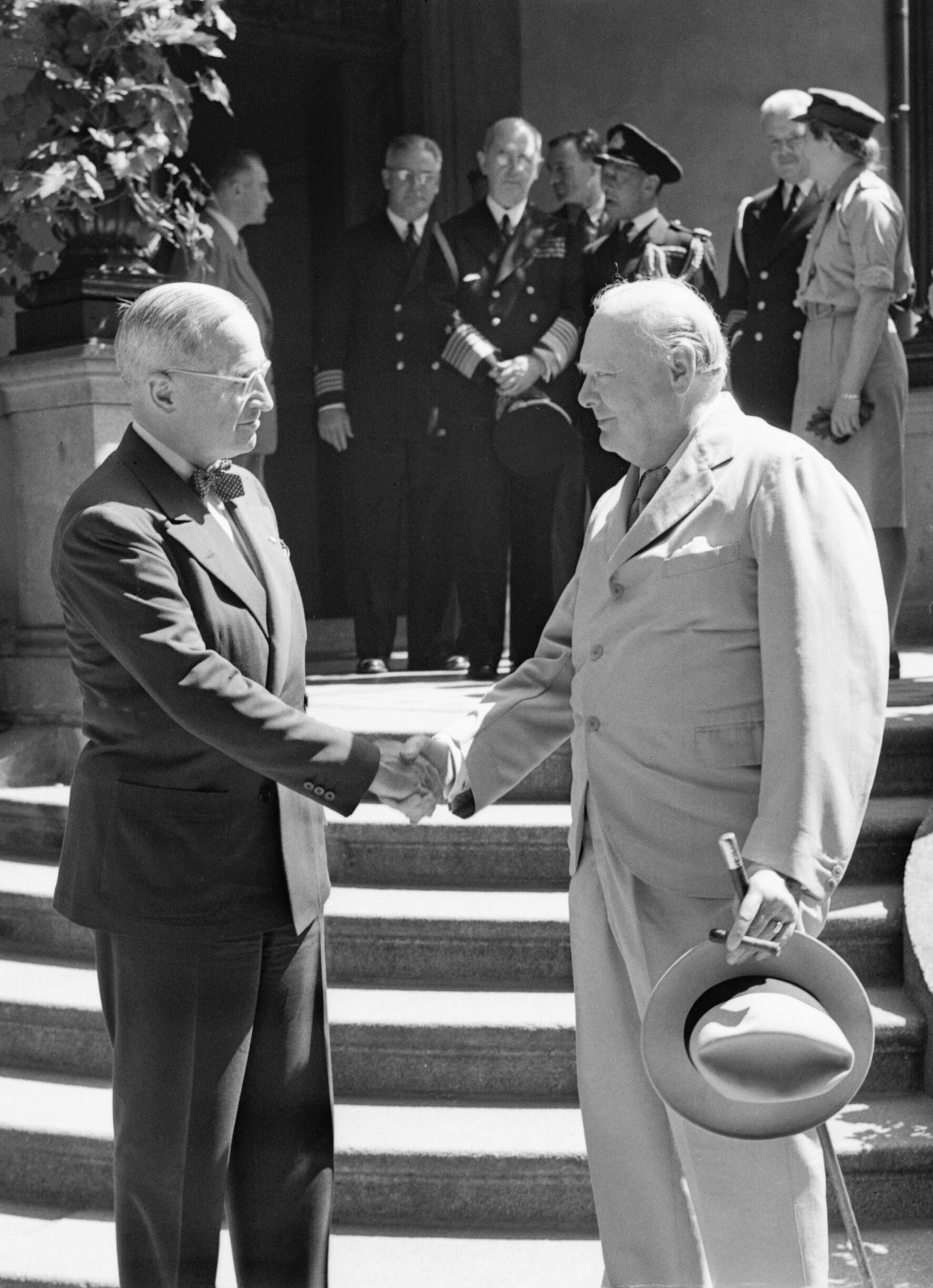
The answer was simple: not much. And neither did Truman win many concessions that favored the Western democracies around the Potsdam negotiating table. Stalin and his cronies got what they came for, except for Greece, which Churchill said he had "pulled from the fire on Christmas Day" during the war, but which would still be menaced by Communist revolutionaries for several years.
The Truman-Churchill story resumed in March 1946 in an unlikely venue: Truman's Presidential train car, the Ferdinand Magellan. As the locomotive sped from Washington to St. Louis, Truman's aides schooled Churchill at the poker table. But card games aside, it was Churchill who was the real teacher. The record of Churchill and Truman's conversation is unavailable, but as the American President is noted for his endless quest for knowledge (he supposedly read every book in his hometown library as a boy) and his British guest for his verbosity, it's likely that the political veteran gave more than a few pointers to his less experienced host.
Churchill was on his way to Truman's home state because the President had added a persuasive postscript to a speaking invitation from Franc Bullet McCluer, who presided over Westminster College in Fulton. Truman offered to introduce Churchill if he accepted, and the Leader of the Opposition recognized that he now had the perfect venue to air his grave concerns over the next great threat to world peace: Communism.
Contrary to his later denials issued when Churchill's "Sinews of Peace" speech whipped up a storm of criticism on both sides of the Atlantic, Truman certainly read and was influenced by what is now better known as "The Iron Curtain Speech." In it, Churchill spoke grimly of the iron curtain that had hewn Europe in two. On one side, Britain, France and a handful of countries were struggling to recover from the war, but their citizens enjoyed the freedoms of liberal democracy in their "cottage homes." Not so on the other side of the Iron Curtain, where the peoples of Central and Eastern Europe were subjected to Soviet tyranny. "This is certainly not the Liberated Europe we fought to build up. Nor is it one which contains the essentials of permanent peace," Churchill asserted in the Westminster College gym, as Truman looked on.
Click here to finish reading this story via The Huffington Post.
And don't forget to order my new book, Whistle Stop: How 31,000 Miles of Train Travel, 352 Speeches, and a Little Midwest Gumption Saved the Presidency of Harry Truman

