Showing posts with label Potsdam Conference. Show all posts

Wednesday, December 10, 2014

A Political Apprenticeship: What Winston Churchill Taught Harry Truman

The two men couldn't have been more different. One was born in a magnificent palace, the other in a humble farmhouse. One had been in politics for 40 years, the other was a relative newcomer. One was lauded as his country's greatest Prime Minister. The other was derided as an accidental President.
And yet, as the Allies won World War Two and tried to make the peace, Winston Spencer Churchill and Harry [invented middle initial] S. Truman came together to check the advance of expansionist communism.
When the two first met in the grounds of the Cecilienhof Palace in Germany in July 1945, the overtones of the Potsdam Conference could not be more clear, or more menacing. A giant red star was daubed on the main lawn, and having sacrificed up to 20 million Soviet lives to repel the Wermacht on the Eastern Front, the ruthless Joseph Stalin was expecting a large slice of European pie as a reward.
2014-12-08-PotsdamStar.jpg
Since well before he ran one of the most dogged and, ultimately, successful PR campaigns of his career to court Franklin Roosevelt's support in 1940 and 1941, Churchill had realized that for democracy to survive the Nazi assault America would have to be the senior partner, and his beloved Britain the junior. With FDR now gone, it would be up to Truman to prevent Stalin from consuming all of Eastern and Central Europe, and perhaps more.
The two men liked each other from the get go, though their initial impressions are amusingly different. Truman thought that they'd get on fine as long as Churchill didn't give him too much "soft soap" - i.e the lofty words and flattery that had wooed FDR. The British bulldog, who had taken the measure of every world leader since the early 1900s, believed Truman to be a man of immense determination. "He takes no notice of solid ground whatsoever," Churchill told his physician. "He just plants his foot down on it." The Prime Minister lifted his bulk a couple of inches into the air and crashed down on his private bathroom floor to illustrate his point.
If Churchill recognized before flying to Potsdam that he would need every ounce of Truman's influence as the head of the West's new superpower, it soon became clear just how much would depend on the Man from Missouri. Halfway through the conference, Churchill flew home to receive news of what he hoped would be victory in the General Election. Instead, his Conservative Party suffered the second worst defeat in its history, meaning Churchill would play no further part in the deliberations. In his stead went the new PM Clement Attlee, a man Churchill had once allegedly referred to as "a sheep in sheep's clothing." What good would a meek lamb be against the Soviet bear?
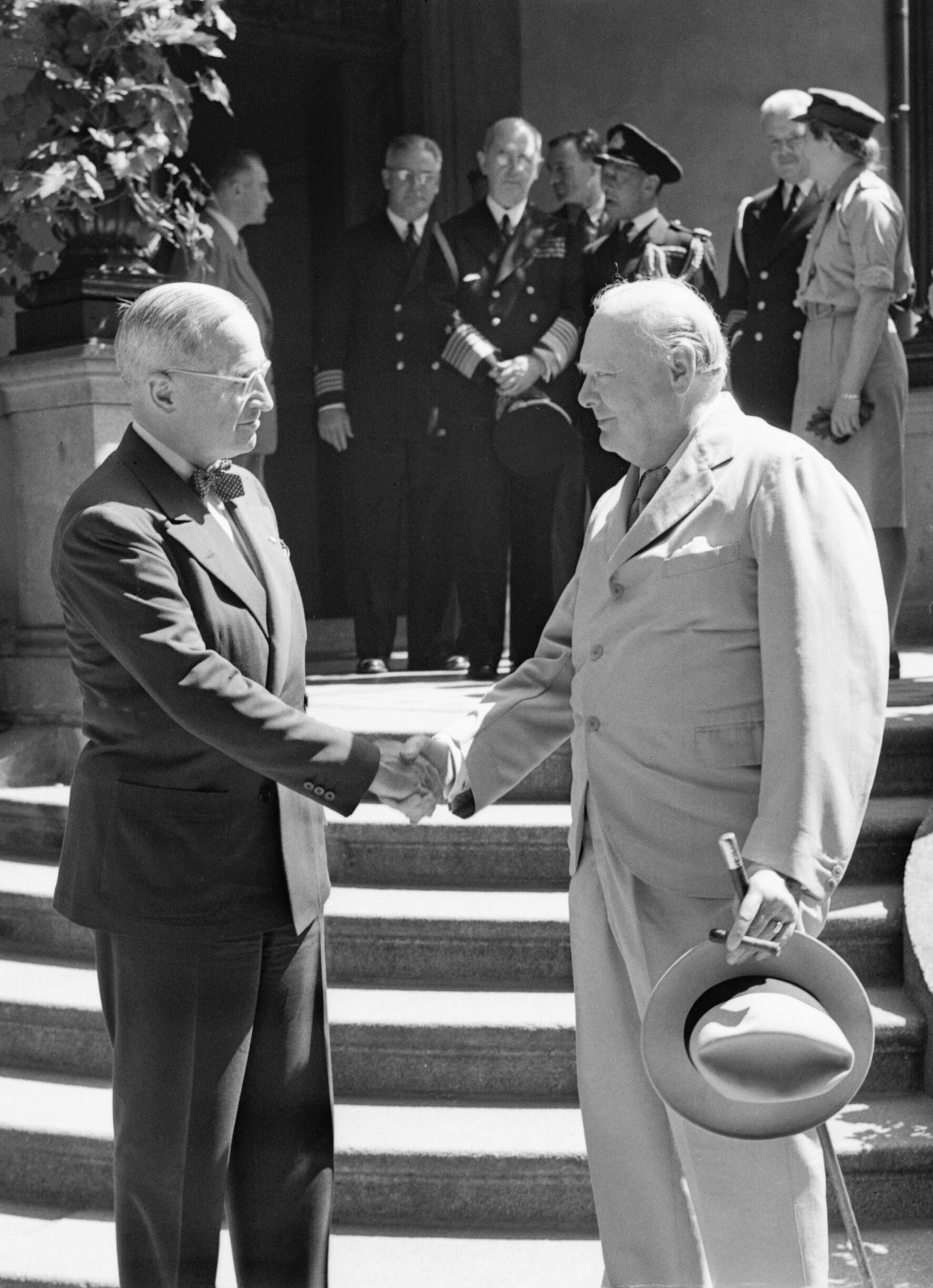
2014-12-08-ChurchillTrumanPotsdam.jpg
The answer was simple: not much. And neither did Truman win many concessions that favored the Western democracies around the Potsdam negotiating table. Stalin and his cronies got what they came for, except for Greece, which Churchill said he had "pulled from the fire on Christmas Day" during the war, but which would still be menaced by Communist revolutionaries for several years.
The Truman-Churchill story resumed in March 1946 in an unlikely venue: Truman's Presidential train car, the Ferdinand Magellan. As the locomotive sped from Washington to St. Louis, Truman's aides schooled Churchill at the poker table. But card games aside, it was Churchill who was the real teacher. The record of Churchill and Truman's conversation is unavailable, but as the American President is noted for his endless quest for knowledge (he supposedly read every book in his hometown library as a boy) and his British guest for his verbosity, it's likely that the political veteran gave more than a few pointers to his less experienced host.
Churchill was on his way to Truman's home state because the President had added a persuasive postscript to a speaking invitation from Franc Bullet McCluer, who presided over Westminster College in Fulton. Truman offered to introduce Churchill if he accepted, and the Leader of the Opposition recognized that he now had the perfect venue to air his grave concerns over the next great threat to world peace: Communism.
Contrary to his later denials issued when Churchill's "Sinews of Peace" speech whipped up a storm of criticism on both sides of the Atlantic, Truman certainly read and was influenced by what is now better known as "The Iron Curtain Speech." In it, Churchill spoke grimly of the iron curtain that had hewn Europe in two. On one side, Britain, France and a handful of countries were struggling to recover from the war, but their citizens enjoyed the freedoms of liberal democracy in their "cottage homes." Not so on the other side of the Iron Curtain, where the peoples of Central and Eastern Europe were subjected to Soviet tyranny. "This is certainly not the Liberated Europe we fought to build up. Nor is it one which contains the essentials of permanent peace," Churchill asserted in the Westminster College gym, as Truman looked on.

Click here to finish reading this story via The Huffington Post.

And don't forget to order my new book, Whistle Stop: How 31,000 Miles of Train Travel, 352 Speeches, and a Little Midwest Gumption Saved the Presidency of Harry Truman

Friday, December 14, 2012

A Legacy of Leadership: Happy 138th, Winston

November 30 was Winston Churchill’s birthday. 138 years after his birth, historians, politicians and the public are still as fascinated as ever about this most iconic of British Prime Ministers. Of course, as with every major historical figure, the amount of one-sided deconstructionismhas increased over the past few years, no more useful to the reader than one-sided hagiography. The truth, of course, lies somewhere in the middle–a deeply flawed (aren’t we all!) larger-than-life figure who botched a lot of decisions–notably his resistance to home rule for India and well-meaning but ill-conceived support of Edward VIII during the 1936 abdication crisis–who got the big things right.


Among the latter was Churchill’s foresight over the divisions between the democratic West and the Communist East. Since the inception of Communism and its violent manifestation in the Russian Revolution, Churchill had despised the movement, calling it a “pestilence.” Certainly, his monarchial devotion was part of this, but more so, Churchill believed Communism destroyed the very principles of liberty and freedom that he would devote his career to advancing and defending. 

Certainly, with his love of Empire, there were some inconsistencies in his thinking, but above all, Churchill believed that the individual should be able to make choices and that systemic freedom–of the press, of religion, of the ballot, must be upheld for individuals to enact such choices. That’s why he vowed to “strangle Bolshevism in its cradle,” though his plan to bolster anti-Communist forces was quickly shot down by Woodrow Wilson and David Lloyd George as another of “Winston’s follies.”

In this case, his plan to oppose Communism was indeed unrealistic. There were a small amount of British, Canadian, and American troops and a trickle of supporting materiel going to aid the White Russians toward the end of World War I, but once the Armistice was signed on November 11, 1918, the Allied leaders wanted to get their boys home, not commit more to a seemingly hopeless cause.

But over the next three decades, Churchill’s ideas on how to deal with Communism became more informed, more realistic and, arguably, more visionary. Though he reluctantly accepted Stalin as an ally when Hitler turned on Russia in the fateful summer of 1941, Churchill’s pragmatism and public admiration of the Marshal did not blind him to the ills of the Communist system. The Percentages Agreement he signed with Stalin in a late 1944 meeting has since been blamed for hastening the fall of democratic Eastern Europe, but what Churchill was actually doing there was essentially recognizing that the Communist takeover was a fait accompli, and guaranteeing Stalin’s agreement to largely leave the Greek Communists to their own devices in Greece after World War II. Though Moscow did supply arms and it took the Marshall Plan to prop up the anti-Communist side in Greece, Stalin largely honored this pledge.

He was not so good on his word with many other things, however. Among the promises he made to Churchill and FDR were to include the London Poles (exiled during the war) in a so-called representative government in Poland. In fact, the Communist puppet Lublin Poles ran the new regime after the war, and the old guard was either shunned or killed. In fact, horrifyingly, many of the leaders of the Polish Underground were taken out by Stalin’s henchmen, and others were held in former Nazi camps that the Red Army had supposedly “liberated.” 


At the Potsdam Conference in July 1946, Stalin showed that his vows at Yalta were mere lip service to the British and American leaders. He made demands for bases in Turkey, threatened the vital British trade route through the Suez canal and refused to withdraw troops from oil-rich Iran.

Churchill, still putting his faith in personal diplomacy, believed he could reason with Stalin, particularly if Harry Truman backed him up. But halfway through the Potsdam meeting the British public sent the Conservative Party to its second worst defeat in one of the most surprising General Election decisions. Churchill was out as Prime Minister and Clement Attlee was in. Off Attlee went to Germany to finish the dialogue with Truman and Stalin. Churchill feared he was headed for political oblivion. 

Yet, after a few weeks of moping, he realized that he still had his pen and, as arguably the most famous democratic leader of the age (only FDR came close in global renown), his voice.
  Click here to keep reading at the blog of Boston University's Historical Society

Wednesday, May 30, 2012

Winston Churchill's Short-Lived VE Day Victory, and His Memorable Comeback


May 8, 1945. London. Winston Churchill stands alongside King George VI and other members of the Royal Family on a Buckingham Palace balcony, waving to a crowd of thousands who've gathered to celebrate with him the fall of Germany, and victory in Europe.

For Churchill, this was the defining moment of his career, a career that had once seemed, even to him, to be quickly fading away, as he shouted his clarion call about the Nazi menace from the fringe of the Conservative Party in the mid to late 1930s. Having put himself there with his lamentable, pro-Empire denial of India's independence and his monarchist knee-jerk reaction of supporting Edward VIII during the abdication crisis, (not to mention his relentless criticism of Stanley Baldwin and Neville Chamberlain's appeasement), Churchill must have thought many times that he would never rise to the position he had once felt fated for: Prime Minister, in England's darkest hour.

And yet, when the shadow fell as the Wermacht marched unchecked and unchallenged across Europe, it fell to Churchill to rally his ill-prepared nation, to woo FDR for weapons (until Pearl Harbor propelled the United States into the war) and to stare down Hitler as the future of Europe and, arguably, global democracy hung by the finest of threads.

Almost five years to the day after he assumed the highest office in the land (May 10, 1940), Churchill now savoured the victory over his mortal foe. He had promised "Blood, Toil, Tears and Sweat" in his first speech as Prime Minister and had contributed all he had in the course of a seemingly endless string of long days and nights, through inspiring ups (such as winning the air war in the Battle of Britain and cracking the German U-boat code) and spirit-sapping downs (the fall of Singapore, the capitulation of France).

After his palace appointment and addressing the nation from the Cabinet Room at 10 Downing Street, Churchill spoke to a rapturous crowd from a balcony outside the Ministry of Health. Afterwards, they showed their appreciated with a rendition of For He's a Jolly Good Fellow.

With such an endorsement ringing in his ears, it's easy to see why Churchill thought he would handily defeat Labour leader Clement Attlee in the General Election that soon followed. And yet, on July 26, the day of the results, he knew something was very wrong: "...just before dawn I woke suddenly with a sharp stab of almost physical pain. A hitherto subconscious conviction that we were beaten broke forth and dominated my mind." And so it proved. And not just beaten, but routed: Labour won 393 seats, giving them a majority of 183 in the Commons.

Finish reading this post at, err, the Huffington Post

Friday, October 7, 2011

Surviving a Book Edit

The title of this blog post may have drawn more readers if it read “Surviving a Shark Attack” or “Surviving a Tsunami” but, though it may lack the same drama, I hope this particular musing will be more useful for the would-be book writer.

I have been working on my book (shameless plug alert!), Our Supreme Task: How Winston Churchill’s Iron Curtain Speech Defined the Cold War Alliance, since March 2009. From its genesis, it has gone through multiple metamorphoses, with entire chapters re-written and axed, new sources discovered and integrated, and days spent at the Churchill Archives Center, the National Churchill Museum,the Harry S. Truman Library and other archival treasure troves.

When I first settled on September 1 as my manuscript submission date, almost nine months ago, it seemed a lifetime away. After all, I’d already put hundreds or even thousands of hours into the project, had what I thought were five complete chapters (of 11) on my hard drive, and was rolling along with the remainder.

However, the deadline that once seemed so far off soon appeared right before my nose, like the knights caught unawares by Sir Lancelot in Monty Python and the Holy Grail. Liz Murphy, archivist at the National Churchill museum, came across a batch of pertinent Churchill letters just days before, and I was still hurrying to incorporate this new material. I was also hastily acquiring rights for photos from the Potsdam Conference and Churchill’s 1946 visit to the U.S., while trying to cut bloat from certain chapters. Arrggh! I thought I had this under control! How did it become this mad panic?

Anyway, I got the manuscript and images away a couple days early, and took a deep breath. Two weeks later, my editor mailed back a Yellow Pages-sized packet of paper, with red pen to indicate her first read comments and blue pen to show comments from the second pass (how is she so fast and efficient - I have no idea!). The first eight chapters were smooth sailing, but numbers nine and eleven were anything but – too much detail, too long, too everything other than ready to go to print. So I spent an entire day cutting away, and eventually, after four and a half days of hard work, sent back my response to her comments. In the midst of cutting almost 20,000 words, re-formatting a chapter and putting my pride to the sword, here’s what I learned:


Click here to read the full post on the blog of The Historical Society