Wednesday, May 30, 2012
Winston Churchill's Short-Lived VE Day Victory, and His Memorable Comeback
May 8, 1945. London. Winston Churchill stands alongside King George VI and other members of the Royal Family on a Buckingham Palace balcony, waving to a crowd of thousands who've gathered to celebrate with him the fall of Germany, and victory in Europe.
For Churchill, this was the defining moment of his career, a career that had once seemed, even to him, to be quickly fading away, as he shouted his clarion call about the Nazi menace from the fringe of the Conservative Party in the mid to late 1930s. Having put himself there with his lamentable, pro-Empire denial of India's independence and his monarchist knee-jerk reaction of supporting Edward VIII during the abdication crisis, (not to mention his relentless criticism of Stanley Baldwin and Neville Chamberlain's appeasement), Churchill must have thought many times that he would never rise to the position he had once felt fated for: Prime Minister, in England's darkest hour.
And yet, when the shadow fell as the Wermacht marched unchecked and unchallenged across Europe, it fell to Churchill to rally his ill-prepared nation, to woo FDR for weapons (until Pearl Harbor propelled the United States into the war) and to stare down Hitler as the future of Europe and, arguably, global democracy hung by the finest of threads.
Almost five years to the day after he assumed the highest office in the land (May 10, 1940), Churchill now savoured the victory over his mortal foe. He had promised "Blood, Toil, Tears and Sweat" in his first speech as Prime Minister and had contributed all he had in the course of a seemingly endless string of long days and nights, through inspiring ups (such as winning the air war in the Battle of Britain and cracking the German U-boat code) and spirit-sapping downs (the fall of Singapore, the capitulation of France).
After his palace appointment and addressing the nation from the Cabinet Room at 10 Downing Street, Churchill spoke to a rapturous crowd from a balcony outside the Ministry of Health. Afterwards, they showed their appreciated with a rendition of For He's a Jolly Good Fellow.
With such an endorsement ringing in his ears, it's easy to see why Churchill thought he would handily defeat Labour leader Clement Attlee in the General Election that soon followed. And yet, on July 26, the day of the results, he knew something was very wrong: "...just before dawn I woke suddenly with a sharp stab of almost physical pain. A hitherto subconscious conviction that we were beaten broke forth and dominated my mind." And so it proved. And not just beaten, but routed: Labour won 393 seats, giving them a majority of 183 in the Commons.
Finish reading this post at, err, the Huffington Post


Wednesday, April 25, 2012
Standing Desks: Jefferson, Disraeli, Churchill and, Err, Dwight K. Schrute
Stand up desks are becoming quite hip, even making it onto an episode of The Office. And speaking of hips (and, indeed, lower backs), I cured a persistent pain issue by standing to type for 2/3 of my day/night work hours. The evidence seems conclusive that sitting all day is terrible for your lumbar spine, increases the risk of heart disease and piles on the pounds like you’ve done on a Kansas City barbecue-only diet.

One thing that’s also for sure, although often overlooked, is that standing to write is nothing new. Thomas Jefferson designed a six-legged standing desk, the extra pegs adding stability. The great British statesman Benjamin Disraeli, like many of his Victorian age, preferred to be on his feet when writing. And, though he far preferred dictation as his primary composition method, Disraeli’s countryman and fellow prime minister, Winston Churchill, followed suit when he picked up his fountain pen.
And elevated desks have not been confined to the offices of heads of state. Ernest Hemingwayconsidered it soft to sit (OK, I have NO basis for that, but I can imagine him growling something similar) and, before him, Charles Dickens and Virginia Woolf scrawled away at a standing desk. More recent proponents include Philip Roth.
Click here to keep reading at the blog of Boston University's Historical Society
One thing that’s also for sure, although often overlooked, is that standing to write is nothing new. Thomas Jefferson designed a six-legged standing desk, the extra pegs adding stability. The great British statesman Benjamin Disraeli, like many of his Victorian age, preferred to be on his feet when writing. And, though he far preferred dictation as his primary composition method, Disraeli’s countryman and fellow prime minister, Winston Churchill, followed suit when he picked up his fountain pen.
And elevated desks have not been confined to the offices of heads of state. Ernest Hemingwayconsidered it soft to sit (OK, I have NO basis for that, but I can imagine him growling something similar) and, before him, Charles Dickens and Virginia Woolf scrawled away at a standing desk. More recent proponents include Philip Roth.
Click here to keep reading at the blog of Boston University's Historical Society
Monday, April 16, 2012
On the Road Again: Dispatches from a Traveling Writer
Since the March 6 release of my book about Winston Churchill’s unlikely journey to Fulton, Missouri in March 1946–Our Supreme Task–I’ve been busier than usual on the lecture circuit, not to mention with newspaper, radio and (gulp!) TV interviews. Now, we're not talking J.K. Rowling's schedule here (or, more's the pity, her royalties) but a fine publicist + the continued fascination in all things Churchill + the local history angle = a few new and formative experiences. And a few terrifying ones.
The first stop was the Big Apple, where I’d never set foot before Saturday, March 3. Fortunately a lifelong friend has lived there for seven years, and proved an informed and gracious host. Within five hours of landing at La Guardia, he’d whisked me to the Met, put up with my sensory overload at Strand Book Store–where I could have happily squandered a year’s wages–and taken me back in time at the Café Sabarsky, with its wood paneling, grand piano and the best chocolat chaud this side of Vienna. Over the next two days, we consumed more spicy, rich Indian food and its buddy, Kingsfisher lager, than I had in the previous two months, and burned it off by traversing Brooklyn, the Garment District and the East Village.

Then the heat was really on. Any time you have to set three alarms it’s gotta be early, and the 4:15 a.m. EST wakeup call on Tuesday, March 6 (the day after the anniversary of Churchill’s "Iron Curtain" speech, which I explore in my book) was certainly that. The chilly morning air and a vacuumed down double espresso shocked the sleep out of me, and my publicist and I walked from the edge of a still-dormant Times Square to the Fox & Friends studio on 6th Avenue, where the following occurred:
The first stop was the Big Apple, where I’d never set foot before Saturday, March 3. Fortunately a lifelong friend has lived there for seven years, and proved an informed and gracious host. Within five hours of landing at La Guardia, he’d whisked me to the Met, put up with my sensory overload at Strand Book Store–where I could have happily squandered a year’s wages–and taken me back in time at the Café Sabarsky, with its wood paneling, grand piano and the best chocolat chaud this side of Vienna. Over the next two days, we consumed more spicy, rich Indian food and its buddy, Kingsfisher lager, than I had in the previous two months, and burned it off by traversing Brooklyn, the Garment District and the East Village.
Then the heat was really on. Any time you have to set three alarms it’s gotta be early, and the 4:15 a.m. EST wakeup call on Tuesday, March 6 (the day after the anniversary of Churchill’s "Iron Curtain" speech, which I explore in my book) was certainly that. The chilly morning air and a vacuumed down double espresso shocked the sleep out of me, and my publicist and I walked from the edge of a still-dormant Times Square to the Fox & Friends studio on 6th Avenue, where the following occurred:
Click here to continue reading at the blog of Boston University's The Historical Society
Thursday, April 12, 2012
Syria: Have Our 'Best and Brightest' Learned Nothing From History?
I recently wrote about Kofi Annan's peace plan for Syria, and how I hoped it was not too late for the Syrian people living under President Bashar al-Assad's tyranny. Unfortunately, my worst fears have been realized on this matter: Assad continues his assaults on the 'rebels,' all the while thumbing his nose at the democratic West and the U.N.
We should have seen this coming. Certainly, our leaders, the latest "best and brightest" contingent who represent us, should have. But, as is so often the case, we chose to overlook the lessons of history, instead favoring optimism and faith in our fellow (hu)man.
Even a basic grasp of the recent past would have spared us the wasted time of frowning at Assad and threatening him with sanctions, which to a dictator like him are about as effective as trying to stop a grizzly charge with a pea shooter. And, more importantly, we could have DONE SOMETHING to help the poor people of Syria, many of whom simply want the right to vote, the rule of law, and the other freedoms we take for granted. Instead, as Assad spoke out of one side of his mouth to agree to the ceasefire, he spoke out of the other to order his generals to continue the killing.
Part of the problem is that it is human nature to assume we are on a level playing field with our adversaries and that they will respect supposedly universal standards of engagement - the Queensbury Rules of international politics. Yet, with dictators from Stalin to Hitler to Saddam Hussein, this is not the case.
They don't care about the rules because they consider themselves above them - the megalomania and arrogance that every tyrant I can recall possesses. They also have the assurance of protection by armaments, which just fuels their blind disregard for the Geneva Convention, the Charter of the United Nations and any other coda that democratic nations abide by. The dictator views ruling by committee as weakness, diplomatic exchange as folly, and assurances of cooperation as contemptible, only to be used to buy time to solidify the position of strength.
And so it goes with Assad.
He will not be deposed by ceasefire plans, by transition strategies or by diplomatic engagement. The only language he understands is force, or, as Harry Truman put it about the Soviet Union, the simple question of "how many divisions do you have?" This is not to say that a full-scale ground invasion is needed, or, indeed, that it would do anything other than ignite the tinderbox of the Middle East. Yet we have seen recently (in the case of Libya) and not so long ago (in Bosnia), that there are other, smarter ways to topple a man like Assad. Regardless of what Britain and America do - for with certain nations continually exercising their vetoes in irresponsible fashion in the UN, it may be time for independent action - the window for talking has been slammed down on our fingers.
More Syrian men, women and children are dying by the day. How long will we allow this continue?
We should have seen this coming. Certainly, our leaders, the latest "best and brightest" contingent who represent us, should have. But, as is so often the case, we chose to overlook the lessons of history, instead favoring optimism and faith in our fellow (hu)man.
Even a basic grasp of the recent past would have spared us the wasted time of frowning at Assad and threatening him with sanctions, which to a dictator like him are about as effective as trying to stop a grizzly charge with a pea shooter. And, more importantly, we could have DONE SOMETHING to help the poor people of Syria, many of whom simply want the right to vote, the rule of law, and the other freedoms we take for granted. Instead, as Assad spoke out of one side of his mouth to agree to the ceasefire, he spoke out of the other to order his generals to continue the killing.
Part of the problem is that it is human nature to assume we are on a level playing field with our adversaries and that they will respect supposedly universal standards of engagement - the Queensbury Rules of international politics. Yet, with dictators from Stalin to Hitler to Saddam Hussein, this is not the case.
They don't care about the rules because they consider themselves above them - the megalomania and arrogance that every tyrant I can recall possesses. They also have the assurance of protection by armaments, which just fuels their blind disregard for the Geneva Convention, the Charter of the United Nations and any other coda that democratic nations abide by. The dictator views ruling by committee as weakness, diplomatic exchange as folly, and assurances of cooperation as contemptible, only to be used to buy time to solidify the position of strength.
And so it goes with Assad.
He will not be deposed by ceasefire plans, by transition strategies or by diplomatic engagement. The only language he understands is force, or, as Harry Truman put it about the Soviet Union, the simple question of "how many divisions do you have?" This is not to say that a full-scale ground invasion is needed, or, indeed, that it would do anything other than ignite the tinderbox of the Middle East. Yet we have seen recently (in the case of Libya) and not so long ago (in Bosnia), that there are other, smarter ways to topple a man like Assad. Regardless of what Britain and America do - for with certain nations continually exercising their vetoes in irresponsible fashion in the UN, it may be time for independent action - the window for talking has been slammed down on our fingers.
More Syrian men, women and children are dying by the day. How long will we allow this continue?
Wednesday, March 28, 2012
The U.N. and Syria: A "Mere Frothing of Words?"
In the past week, U.N. Special Envoy Kofi Annan proposed a six-point plan for ending the violence and oppression in Syria. As of today, the Arab League was discussing his proposal, and was expected to endorse it.

Syria itself has accepted Mr. Annan's call for a ceasefire and his other five points, though it has a long history of violating such agreements whenever President Bashar al-Assad feels like it. Shelling his citizens, including women and children. Torturing dissidents. Imprisoning journalists. These are the hallmarks of Assad's dictatorship.
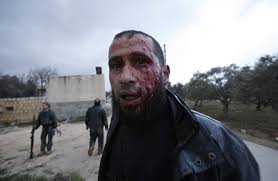
I applaud Annan's active diplomacy, his courage and his leadership. The former U.N. Secretary General has built his reputation on such pillars, in stark contrast with the Syrian despot he is attempting to peaceably remove.
However, I question why it took the United Nations so long to create such a plan. Same goes for the Arab League, which expelled Syria last year and yet has done little to effectively curb Assad's abuses.
During his March 1946 speech in Fulton, Mo., (actually called "The Sinews of Peace" but soon re-christened "The Iron Curtain speech"), Winston Churchill's most famous soundbytes were his definition of the Iron Curtain and the "special relationship" between the English-speaking peoples, led by Britain and America. Yet there are other significant messages therein that are often overlooked.
One such message is Churchill's urging that the U.N. become a "temple of peace" instead of a "Tower of Babel." Churchill also cautioned against the fledgling association succumbing to a "mere frothing of words" rather than active diplomacy backed by strength. He had witnessed first hand the failure of The League of Nations to achieve its primary aim, namely that World War I should be "the war to end all wars." With Nazism gone but the specter of Communism darkening Eastern Europe and menacing the Middle and Far East, Churchill realized that the new version of the League would have its work cut out. And so it proved.
While the U.N. eventually took decisive measures in Bosnia (thanks in no small part to President Bill Clinton's leadership) and has other successes it can be proud of, its record is blighted with inaction in Zimbabwe, Rwanda and Uganda, to name just three. This is not to say that the U.N. should be a hawkish organization that authorizes pre-emptive strikes or full-scale ground invasions every week. But neither should it, neither can it, sit idly by while ethnic cleansing, Assad-style brutality, and genocide occur under its very nose.
Churchill's advice?
"We must make sure that its work is fruitful, that it is a reality and not a sham, that it is a force for action, and not merely a frothing of words, that it is a true temple of peace in which the shields of many nations can some day be hung up, and not merely a cockpit in a Tower of Babel. Before we cast away the solid assurances of national armaments for self-preservation we must be certain that our temple is built, not upon shifting sands or quagmires, but upon the rock."
Or, roughly translated, the U.N. must be a body built on "the rock" of close associations within the Anglosphere, a body of nations committed to defending those who cannot defend themselves in word and in deed.
Congratulations to Mr. Annan on putting Churchill's timeless guidance into action. I hope it is not too late for the Syrian people.
Syria itself has accepted Mr. Annan's call for a ceasefire and his other five points, though it has a long history of violating such agreements whenever President Bashar al-Assad feels like it. Shelling his citizens, including women and children. Torturing dissidents. Imprisoning journalists. These are the hallmarks of Assad's dictatorship.
I applaud Annan's active diplomacy, his courage and his leadership. The former U.N. Secretary General has built his reputation on such pillars, in stark contrast with the Syrian despot he is attempting to peaceably remove.
However, I question why it took the United Nations so long to create such a plan. Same goes for the Arab League, which expelled Syria last year and yet has done little to effectively curb Assad's abuses.
During his March 1946 speech in Fulton, Mo., (actually called "The Sinews of Peace" but soon re-christened "The Iron Curtain speech"), Winston Churchill's most famous soundbytes were his definition of the Iron Curtain and the "special relationship" between the English-speaking peoples, led by Britain and America. Yet there are other significant messages therein that are often overlooked.
One such message is Churchill's urging that the U.N. become a "temple of peace" instead of a "Tower of Babel." Churchill also cautioned against the fledgling association succumbing to a "mere frothing of words" rather than active diplomacy backed by strength. He had witnessed first hand the failure of The League of Nations to achieve its primary aim, namely that World War I should be "the war to end all wars." With Nazism gone but the specter of Communism darkening Eastern Europe and menacing the Middle and Far East, Churchill realized that the new version of the League would have its work cut out. And so it proved.
While the U.N. eventually took decisive measures in Bosnia (thanks in no small part to President Bill Clinton's leadership) and has other successes it can be proud of, its record is blighted with inaction in Zimbabwe, Rwanda and Uganda, to name just three. This is not to say that the U.N. should be a hawkish organization that authorizes pre-emptive strikes or full-scale ground invasions every week. But neither should it, neither can it, sit idly by while ethnic cleansing, Assad-style brutality, and genocide occur under its very nose.
Churchill's advice?
"We must make sure that its work is fruitful, that it is a reality and not a sham, that it is a force for action, and not merely a frothing of words, that it is a true temple of peace in which the shields of many nations can some day be hung up, and not merely a cockpit in a Tower of Babel. Before we cast away the solid assurances of national armaments for self-preservation we must be certain that our temple is built, not upon shifting sands or quagmires, but upon the rock."
Or, roughly translated, the U.N. must be a body built on "the rock" of close associations within the Anglosphere, a body of nations committed to defending those who cannot defend themselves in word and in deed.
Congratulations to Mr. Annan on putting Churchill's timeless guidance into action. I hope it is not too late for the Syrian people.
Tuesday, March 6, 2012
Israel, Obama & Iran: What Can Winston Churchill Teach Us?
Today I appeared on the Fox News morning show, Fox & Friends, to discuss how Winston Churchill's Iron Curtain speech holds key lessons on diplomacy as Israel and the democratic West attempts to prevent Iran from acquiring a nuclear weapon. I will write more on this in the coming days. Click here to watch the interview
Sunday, March 4, 2012
Vladimir Putin, Winston Churchill and the Trampling of Democracy
Tomorrow, March 5, marks the 66th anniversary of Winston Churchill's The Sinews of Peace address, better known as the "Iron Curtain" speech. A lot has changed since Churchill took the podium at Westminster College in Fulton, Missouri, in 1946. And yet, while the Soviet Union, the gulags and the KGB are no more, Russia is in many ways no closer to true democracy.
One of the primary reasons for this is the reign of Vladimir Putin, himself an former member of the KGB. Today, Putin won another six years at the helm of his nation in an election that was supposedly democratic. "We won in an open and honest struggle!" he told a rapturous crowd that cheered his victory as they gathered outside the Kremlin on a frigid Moscow night.
Despite Putin's typically bold claims, there have been dozens of reports of voting irregularities and electoral frauds that would be almost laughable if their consequences weren't so serious, including "carousel voting," whereby buses of voters are driven to many different polling stations to punch many ballots. Independent monitors have broadcast these abuses to the world media, but Putin and his cronies simply don't care - they just issue one dismissive denial after another.
In the "Iron Curtain" speech, Churchill stated, "the people of any country have the right, and should have the power by constitutional action, by free unfettered elections, with secret ballot, to choose or change the character or form of government under which they dwell." If the election monitors are to be believed, nothing of the sort took place in Russia. And nor will it at any point during the next stage of Putin's reign, which began in 2000. Maybe in time for the 75th anniversary of Churchill's call for universal democracy and liberty, the Russian people can shake off Putin's yoke and finally take hold of the "title deeds of freedom."
One of the primary reasons for this is the reign of Vladimir Putin, himself an former member of the KGB. Today, Putin won another six years at the helm of his nation in an election that was supposedly democratic. "We won in an open and honest struggle!" he told a rapturous crowd that cheered his victory as they gathered outside the Kremlin on a frigid Moscow night.
Despite Putin's typically bold claims, there have been dozens of reports of voting irregularities and electoral frauds that would be almost laughable if their consequences weren't so serious, including "carousel voting," whereby buses of voters are driven to many different polling stations to punch many ballots. Independent monitors have broadcast these abuses to the world media, but Putin and his cronies simply don't care - they just issue one dismissive denial after another.
In the "Iron Curtain" speech, Churchill stated, "the people of any country have the right, and should have the power by constitutional action, by free unfettered elections, with secret ballot, to choose or change the character or form of government under which they dwell." If the election monitors are to be believed, nothing of the sort took place in Russia. And nor will it at any point during the next stage of Putin's reign, which began in 2000. Maybe in time for the 75th anniversary of Churchill's call for universal democracy and liberty, the Russian people can shake off Putin's yoke and finally take hold of the "title deeds of freedom."
Subscribe to:
Posts (Atom)